136 posters, 2 topics, 27 sessions, 339 authors, 88 institutions
ePostersLive by SciGen Technologies S.A. All rights reserved.
2024 ACP Annual Session
NOVEMBER 6-9, 2024 | MARCO ISLAND, FL JW MARRIOT

123
Examining the State of Dental Laboratories with Respect to Technician Training and Employment in a Digital Era
Poster Presenter
Authors
Affiliations
Part of Topic
Original Research
|
Examining the State of Dental Laboratories with Respect to Technician Training and Employment in a Digital Era Danielle N. Romano, D.M.D. |
|
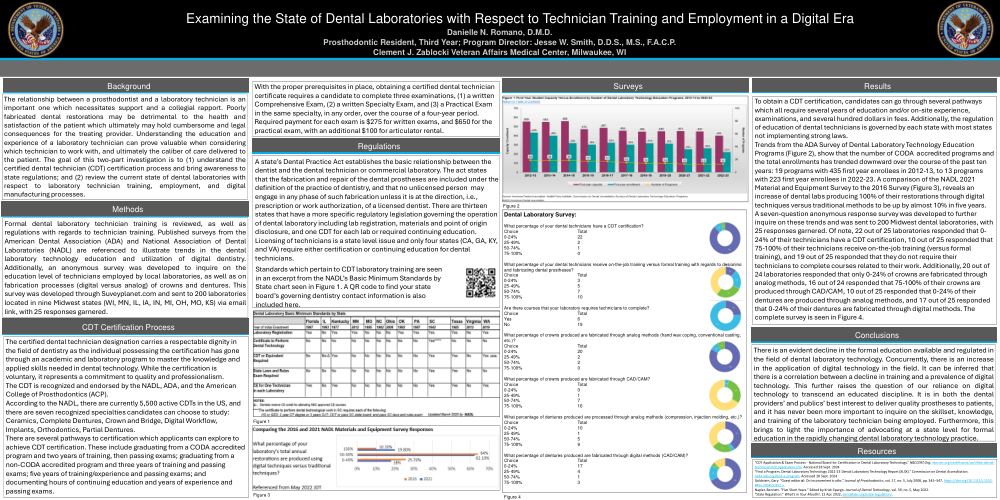
Background Surveys Results The relationship between a prosthodontist and a laboratory technician is an important one which necessitates support and a collegial rapport. Poorly fabricated dental restorations may be detrimental to the health and satisfaction of the patient which ultimately may hold cumbersome and legal consequences for the treating provider. Understanding the education and experience of a laboratory technician can prove valuable when considering which technician to work with, and ultimately the caliber of care delivered to the patient. The goal of this two-part investigation is to (1) understand the certified dental technician (CDT) certification process and bring awareness to state regulations; and (2) review the current state of dental laboratories with respect to laboratory technician training, employment, and digital manufacturing processes. |
|
Methods |
|
Formal dental laboratory technician training is reviewed, as well as regulations with regards to technician training. Published surveys from the American Dental Association (ADA) and National Association of Dental Laboratories (NADL) are referenced to illustrate trends in the dental laboratory technology education and utilization of digital dentistry. Additionally, an anonymous survey was developed to inquire on the education level of technicians employed by local laboratories, as well as on fabrication processes (digital versus analog) of crowns and dentures. This survey was developed through Suveyplanet.com and sent to 200 laboratories located in nine Midwest states (WI, MN, IL, IA, IN, MI, OH, MO, KS) via email link, with 25 responses garnered. |
CDT Certification Process
Conclusions
The certified dental technician designation carries a respectable dignity in the field of dentistry as the individual possessing the certification has gone through an academic and laboratory program to master the knowledge and applied skills needed in dental technology. While the certification is voluntary, it represents a commitment to quality and professionalism.
The CDT is recognized and endorsed by the NADL, ADA, and the American College of Prosthodontics (ACP).
According to the NADL, there are currently 5,500 active CDTs in the US, and there are seven recognized specialties candidates can choose to study: Ceramics, Complete Dentures, Crown and Bridge, Digital Workflow, Implants, Orthodontics, Partial Dentures.
There are several pathways to certification which applicants can explore to achieve CDT certification. These include graduating from a CODA accredited program and two years of training, then passing exams; graduating from a non-CODA accredited program and three years of training and passing exams; five years of training/experience and passing exams; and documenting hours of continuing education and years of experience and passing exams.
With the proper prerequisites in place, obtaining a certified dental technician certificate requires a candidate to complete three examinations, (1) a written Comprehensive Exam, (2) a written Specialty Exam, and (3) a Practical Exam in the same specialty, in any order, over the course of a four-year period. Required payment for each exam is $275 for written exams, and $650 for the practical exam, with an additional $100 for articulator rental.
Regulations
A state’s Dental Practice Act establishes the basic relationship between the dentist and the dental technician or commercial laboratory. The act states that the fabrication and repair of the dental prostheses are included under the definition of the practice of dentistry, and that no unlicensed person may engage in any phase of such fabrication unless it is at the direction, i.e., prescription or work authorization, of a licensed dentist. There are thirteen states that have a more specific regulatory legislation governing the operation of dental laboratory including lab registration, materials and point of origin disclosure, and one CDT for each lab or required continuing education. Licensing of technicians is a state level issue and only four states (CA, GA, KY, and VA) require either certification or continuing education for dental technicians.
Standards which pertain to CDT laboratory training are seen in an excerpt from the NADL’s Basic Minimum Standards by State chart seen in Figure 1. A QR code to find your state board’s governing dentistry contact information is also included here.
To obtain a CDT certification, candidates can go through several pathways which all require several years of education and/or on-site experience, examinations, and several hundred dollars in fees. Additionally, the regulation of education of dental technicians is governed by each state with most states not implementing strong laws.
Results
Trends from the ADA Survey of Dental Laboratory Technology Education Programs (Figure 2), show that the number of CODA accredited programs and the total enrollments has trended downward over the course of the past ten years: 19 programs with 435 first year enrollees in 2012-13, to 13 programs with 223 first year enrollees in 2022-23. A comparison of the NADL 2021 Material and Equipment Survey to the 2016 Survey (Figure 3), reveals an increase of dental labs producing 100% of their restorations through digital techniques versus traditional methods to be up by almost 10% in five years.
A seven-question anonymous response survey was developed to further inquire on these trends and was sent to 200 Midwest dental laboratories, with 25 responses garnered. Of note, 22 out of 25 laboratories responded that 0- 24% of their technicians have a CDT certification, 10 out of 25 responded that 75-100% of their technicians receive on-the-job training (versus formal training), and 19 out of 25 responded that they do not require their technicians to complete courses related to their work. Additionally, 20 out of 24 laboratories responded that only 0-24% of crowns are fabricated through analog methods, 16 out of 24 responded that 75-100% of their crowns are produced through CAD/CAM, 10 out of 25 responded that 0-24% of their dentures are produced through analog methods, and 17 out of 25 responded that 0-24% of their dentures are fabricated through digital methods. The complete survey is seen in Figure 4.
Conclusions
There is an evident decline in the formal education available and regulated in the field of dental laboratory technology. Concurrently, there is an increase in the application of digital technology in the field. It can be inferred that there is a correlation between a decline in training and a prevalence of digital technology. This further raises the question of our reliance on digital technology to transcend an educated discipline. It is in both the dental providers’ and publics’ best interest to deliver quality prostheses to patients, and it has never been more important to inquire on the skillset, knowledge, and training of the laboratory technician being employed. Furthermore, this brings to light the importance of advocating at a state level for formal education in the rapidly changing dental laboratory technology practice.
Resources
“CDT Application & Exam Process - National Board for Certification in Dental Laboratory Technology.” NBCCERT.Org, nbccert.org/certificants/certified-dental- technician/cdt-application.cfm. Accessed 28 Sept. 2024.
“Find a Program, Dental Laboratory Technology 2022-23 Dental Laboratory Technology Report (XLSX).” Commission on Dental Accreditation, coda.ada.org/find-a-program. Accessed 28 Sept. 2024.
Goldstein, Gary. “Guest editorial: On inconvenient truths.” Journal of Prosthodontics, vol. 17, no. 5, July 2008, pp. 345–347, https://doi.org/10.1111/j.1532- 849x.2008.00352.x.
Napier, Bennett. “Five Short Years.” Edited by Kristi Spargo. Journal of Dental Technology, vol. 39, no. 5, May 2022.
“State Regulation.” What’s in Your Mouth?, 12 Apr. 2022, dentallabs.org/state-regulation/.