136 posters, 2 topics, 27 sessions, 339 authors, 88 institutions
ePostersLive by SciGen Technologies S.A. All rights reserved.
2024 ACP Annual Session
NOVEMBER 6-9, 2024 | MARCO ISLAND, FL JW MARRIOT

122
A Comparison of Accuracy of Full Arch Maxillary Digital Impressions with Intraoral Scanners using Two Different Scan Body Systems: An In Vitro Study
Part of Topic
Original Research
With the advancements of intraoral scanners (IOS), it is now possible to obtain a digital impression of a patient’s oral cavity, eliminating the need for conventional impression techniques. For implant restorations, implant scan bodies (ISBs) are used to acquire implant orientation, angulation, and 3D spatial position.1A passive fitting restoration depends on an accurate transfer of spatial orientation and angulation of the implants within the clinically acceptable range of errors.2 Restorations that do not display passive fit can lead to biological and mechanical complications.2 Digital implant impressions offer advantages over conventional impressions, such as reduced risks of distortion during the laboratory phases, improved patient comfort, and reduced chair time.3 Scanning accuracy is shown to be affected by the IOS and geometric features of the ISBs.4 The study's null hypothesis is that there are no differences in accuracy between IOS and ISB.
Two factors that can cause inaccuracy are IOS type and ISB geometry. This study will examine two scan body types with different geometric features and two intraoral scanners to evaluate accuracy in making full arch digital implant impressions.
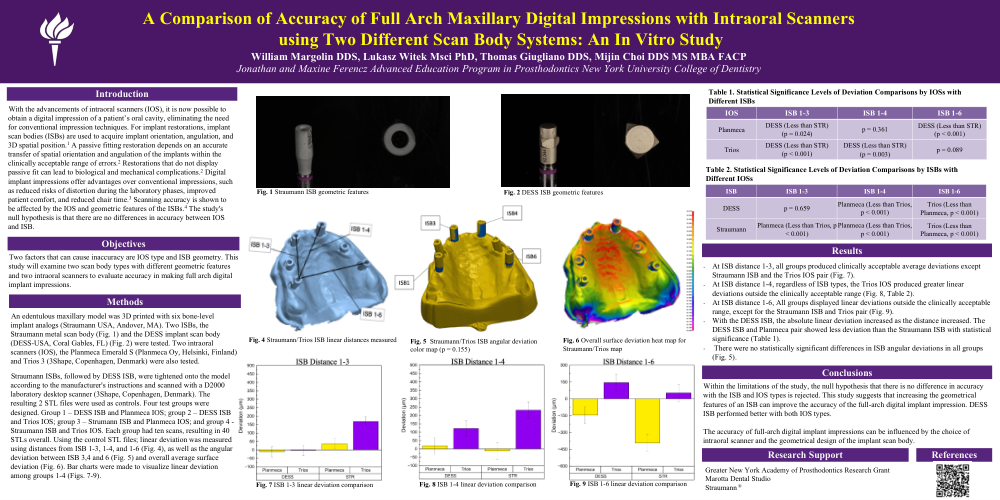
An edentulous maxillary model was 3D printed with six bone-level implant analogs (Straumann USA, Andover, MA). Two ISBs, the DESS implant scan body (DESS-USA, Coral Gables, FL) (Fig. 1) and the Straumann metal scan body (Fig. 2), were tested. Two intraoral scanners (IOS), the Planmeca Emerald S (Planmeca Oy, Helsinki, Finland) and Trios 3 (3Shape, Copenhagen, Denmark), were also tested.
Straumann ISBs, followed by DESS ISB, were tightened onto the model according to the manufacturer's instructions and scanned with a D2000 laboratory desktop scanner (3Shape, Copenhagen, Denmark). The resulting 2 STL files were used as controls. Four test groups were designed. Group 1 – DESS ISB and Planmeca IOS; group 2 – DESS ISB and Trios IOS; group 3 – Strumann ISB and PlanmecaIOS; and group 4 - Straumann ISB and Trios IOS. Each group had ten scans, resulting in 40 STLs overall. Each group was analyzed for overall average surface deviation (Fig. 4). Using the control STL files; linear deviation was measured using the distances from ISB 1-3, 1-4, and 1-6, as well as the angular deviation between ISB 3,4 and 6 (Fig. 5-6). Bar charts were made to visualize linear deviation among groups 1-4 (Fig. 7-9).
Within the limitations of the study, the null hypothesis that there is no difference in accuracy with the ISB and IOS types is rejected. This study suggests that increasing the geometrical features of an ISB can improve the accuracy of the full-arch digital implant impression. DESS ISB performed better with both IOS types.
The accuracy of full-arch digital implant impressions can be influenced by the choice of intraoral scanner and the geometrical design of the implant scan body.