136 posters, 2 topics, 27 sessions, 339 authors, 88 institutions
ePostersLive by SciGen Technologies S.A. All rights reserved.
2024 ACP Annual Session
NOVEMBER 6-9, 2024 | MARCO ISLAND, FL JW MARRIOT

120
AI in prosthodontics - current status and potential applications: literature review
Poster Presenter
Part of Topic
Original Research
INTRODUCTION
Artificial intelligence (AI) is progressively integrating into prosthodontics, transforming diagnostic processes, treatment planning, and prosthesis fabrication. This review critically assess the state-of-art (2021-2024) studies on AI applications in the field of prosthodontics and its implications to build awareness of the current status of the technology in our specialty, and to encourage its responsible integration to the routine workflow.
METHODS
The PubMed and ScienceDirect databases were searched for published studies in the English language from 2021-2024. From the searches, 14 relevant articles were included for original research studies on implications of AI in Prosthodontics.
OVERVIEW
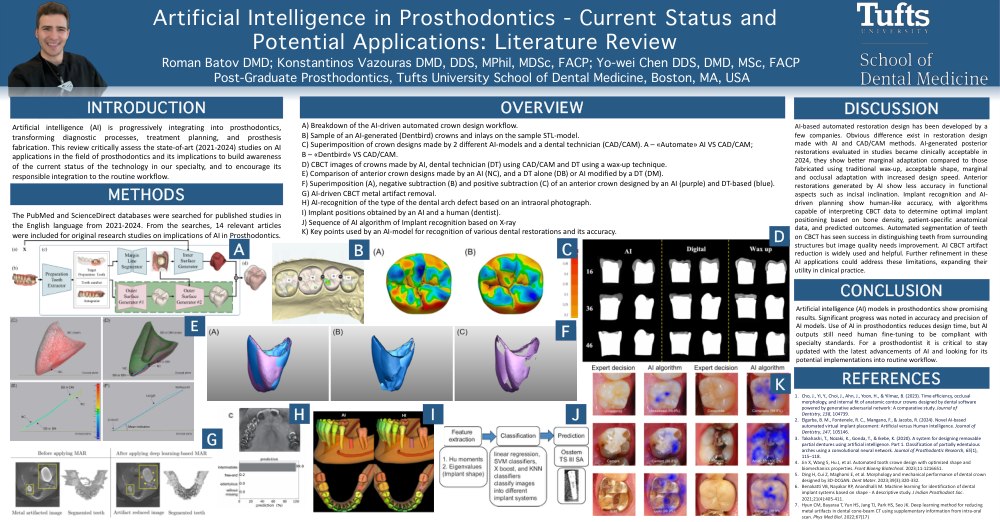
A) Breakdown of the AI-driven automated crown design workflow.
B) Sample of an AI-generated (Dentbird) crowns and inlays on the sample STL-model.
C) Superimposition of crown designs made by 2 different AI-models and a dental technician (CAD/CAM). A – «Automate»AI VS CAD/CAM;
B – «Dentbird» VS CAD/CAM.
D) CBCT images of crowns made by AI,dental technician (DT) using CAD/CAM and DT using a wax-up technique.
E) Comparison of anterior crown designs made by an AI (NC), and a DT alone (DB) or AI modified by a DT (DM).
F) Superimposition (A), negative subtraction (B) and positive subtraction (C) of an anterior crown designed by an AI (purple) and DT-based (blue).
G) AI-driven CBCT metal artifact removal.
H) AI-recognition of the type of the dental arch defect based on an intraoral photograph.
I) Implant positions obtained by an AI and a human (dentist).
J) Sequence of AI algorithm of Implant recognition based on X-ray
K) Key points used by an AI-model for recognition of various dental restorations and its accuracy.
DISCUSSION
AI-based automated restoration design has been developed by a few companies. Obvious differenceexist in restoration design made with AI and CAD/CAM methods. AI-generated posterior restorations evaluated in studies became clinically acceptable in 2024, they show better marginal adaptation compared to those fabricated using traditional wax-up, acceptable shape, marginal and occlusal adaptation with increased design speed. Anterior restorations generated by AI show less accuracy in functional aspects such as incisal inclination. Implant recognition and AI-driven planning show human-like accuracy, with algorithms capable of interpreting CBCT data to determine optimal implant positioning based on bone density, patient-specific anatomical data, and predicted outcomes. Automated segmentation of teeth on CBCT has seen success in distinguishing teeth from surrounding structures but imagequality needs improvement. AI CBCT artifact reduction is widely used and helpful. Furtherrefinement in these AI applications could address these limitations, expanding their utility in clinical practice.
CONCLUSION
Artificial intelligence (AI) models in prosthodontics show promising results. Significant progress was noted in accuracy and precision of AI models. Use of AI in prosthodontics reduces design time, but AI outputs still need human fine-tuning to be compliant with specialty standards. For a prosthodontist it is critical to stay updated with the latest advancements of AI and looking for its potential implementations into routine workflow.
REFERENCES