127 posters, 2 topics, 24 sessions, 326 authors, 85 institutions
ePostersLive by SciGen Technologies S.A. All rights reserved.
2023 ACP ANNUAL SESSION
October 25-28 | San Diego, CA

99
Streamlined CAD/CAM Provisional Crown-Based Core Buildup Technique for Enhanced Restorative Dentistry
Poster Presenter
Authors
Affiliations
Part of Topic
Case Presentation
Streamlined CAD/CAM Provisional Crown-Based Core Buildup Technique
Maj Song K. Lim, DMD, Resident; Col Paul A. Longo, DMD, MS, Assistant Professor
Prosthodontics Residency, JBSA-Lackland, TX Air Force Postgraduate Dental School, Uniformed Services University of the Health Sciences Postgraduate Dental College
INTRODUCTION
The restoration of severely compromised teeth presents a formidable challenge, particularly when it comes to establishing a suitable matrix for core materials. The utilization of a custom-designed provisional crown as a matrix for core buildup emerges as a valuable strategy, offering the dual benefits of preserving the structural integrity of compromised roots and the remaining coronal structure. Historically, various methodologies have been devised to address this challenge, both direct and indirect method, for the fabrication of custom provisional crowns as matrices1-4. In contemporary restorative dentistry, significant progress has been made in the development of materials and techniques aimed at preserving and restoring the structural soundness of compromised teeth. Research indicates that Computer-Aided Design/Computer-Aided Manufacturing (CAD/CAM) fabricated provisional crowns exhibit superior fit and strength when compared to their directly fabricated counterparts5.
The primary objective of this poster presentation is to introduce a novel dental approach that leverages CAD/CAM technology in conjunction with provisional crown matrix techniques to enhance core buildup procedures. This technique is designed to efficiently restore severely compromised teeth while ensuring precision and predictability in the restoration process.
PATIENT PRESENTATION
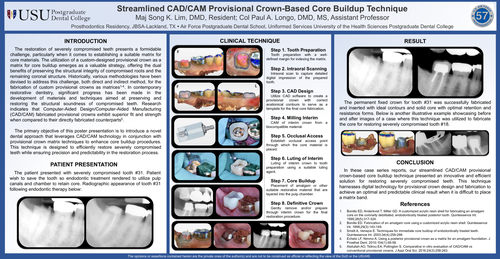
The patient presented with severely compromised tooth #31. Patient wish to save the tooth so endodontic treatment rendered to utilize pulp canals and chamber to retain core. Radiographic appearance of tooth #31 following endodontic therapy below:
CLINICAL TECHNIQUE
Step 1. Tooth Preparation
Tooth preparation with a well-defined margin for indexing the matrix.
Step 2. Intraoral Scanning
Intraoral scan to capture detailed digital impression of the prepared tooth.
Step 3. CAD Design
Utilize CAD software to create a provisional crown with correct anatomical contours to serve as a template for the final core fabrication.
Step 4. Milling Interim
CAM of interim crown from a biocompatible material.
Step 5. Occlusal Access
Establish occlusal access point through which the core material is placed.
Step 6. Luting of Interim
Luting of interim crown to tooth preparation using a suitable luting agent.
Step 7. Core Buildup
Placement of amalgam or other suitable restorative material that are layered into the pulp chamber.
Step 8. Definitive Crown
Gently remove and/or prepare through interim crown for the final restoration procedure.
RESULT
The permanent fixed crown for tooth #31 was successfully fabricated and inserted with ideal contours and solid core with optimal retention and resistance forms. Below is another illustrative example showcasing before and after images of a case where this technique was utilized to fabricate the core for restoring severely compromised tooth #18.
CONCLUSION
In these case series reports, our streamlined CAD/CAM provisional crown-based core buildup technique presented an innovative and efficient solution for restoring severely compromised teeth. This technique harnesses digital technology for provisional crown design and fabrication to achieve an optimal and predictable clinical result when it is difficult to place a matrix band.
References
Bonilla ED, Anderkvist T, Miller GD. A customized acrylic resin shell for fabricating an amalgam core on the coronally debilitated, endodontically treated posterior tooth. Quintessence Int. 1995;26(5):317-324.
Bonilla ED. Fabrication of an amalgam core using a customized acrylic resin shell. Quintessence Int. 1998;29(3):143-149.
Smidt A, Venezia E. Techniques for immediate core buildup of endodontically treated teeth. Quintessence Int. 2003;34(4):258-268.
Echeto LF, Nimmo A. Using a posterior provisional crown as a matrix for an amalgam foundation. J Prosthet Dent. 2010;104(1):56-59.
Abdullah AO, Tsitrou EA, Pollington S. Comparative in vitro evaluation of CAD/CAM vs conventional provisional crowns. J Appl Oral Sci. 2016;24(3):258-263.
The opinions or assertions contained herein are the private ones of the author(s) and are not to be construed as official or reflecting the view of the DoD or the USUHS