127 posters, 2 topics, 24 sessions, 326 authors, 85 institutions
ePostersLive by SciGen Technologies S.A. All rights reserved.
2023 ACP ANNUAL SESSION
October 25-28 | San Diego, CA

105
Integrating Monson's Spherical Theory with Advanced Digital Techniques: A Case Report on Occlusal Plane Determination and Digital Wax-Up for Patients Devoid of Posterior Support
Poster Presenter
Part of Topic
Case Presentation
Integrating Monson's Spherical Theory with Advanced Digital Techniques: A Case Report on Occlusal Plane Determination and Digital Wax-Up for Patients Devoid of Posterior Support
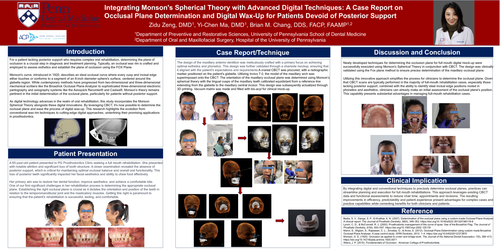
For a patient lacking posterior support who requires complex oral rehabilitation, determining the plane of occlusion is a crucial step in diagnosis and treatment planning. Typically, an occlusal wax rim is crafted and employed to assess esthetics and establish the plane of occlusion using the FOX Plane.
Monson's curve, introduced in 1920, describes an ideal occlusal curve where every cusp and incisal edge either touches or conforms to a segment of an 8-inch diameter sphere's surface, centered around the glabella region. While contemporary methods have progressed from two-dimensional and three-dimensional mechanical scribers like the Broadrick Occlusal Plane Analyzer to sophisticated three-dimensional electronic pantography and axiography systems like the Axioquick Recorder® and Cadiax®, Monson’s theory remains pertinent in the initial determination of the occlusal plane, particularly for patients without posterior support.
As digital technology advances in the realm of oral rehabilitation, this study incorporates the Monson Spherical Theory alongside these digital innovations. By leveraging CBCT, it's now possible to determine the occlusal plane and ease the process of digital wax-up. This research highlights the evolution from conventional wax rim techniques to cutting-edge digital approaches, underlining their promising applications in prosthodontics.