127 posters, 2 topics, 24 sessions, 326 authors, 85 institutions
ePostersLive by SciGen Technologies S.A. All rights reserved.
2023 ACP ANNUAL SESSION
October 25-28 | San Diego, CA

103
A Temporary Fixed Prosthetic Solution for Ectodermal dysplasia with partial anodontia: A case report.
Poster Presenter
Authors
Affiliations
Part of Topic
Case Presentation
A Temporary Fixed Prosthetic Solution for Ectodermal Dysplasia Patients
with Partial Anodontia: A Case Report
Background:
Ectodermal Dysplasia is a rare and challenging hereditary disorder with abnormal development of tissues and structures of ectodermal origin. (1)
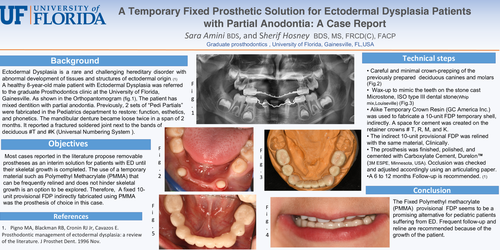
A healthy 8-year-old male patient with Ectodermal Dysplasia was referred to the graduate Prosthodontics clinic at the University of Florida, Gainesville. As shown in the Orthopantomogram (fig.1), The patient has mixeddentition with partial anodontia. Previously, 2 sets of “Pedi Partials” were fabricated in the Pediatrics department to restore: function, esthetics, and phonetics. The mandibular denture became loose twice in a span of 2 months. It reported a fractured soldered joint next to the bands of deciduous #T and #K (Universal Numbering System ).
Objectives:
Most cases reported in the literature propose removable prostheses as an interim solution for patients with ED until their skeletal growth is completed. The use of a temporary material such as Polymethyl Methacrylate (PMMA) that can be frequently relined and does not hinder skeletal growth is an option to be explored. Therefore, A fixed 10-unit provisional FDP indirectly fabricated using PMMA was the prosthesis of choice in this case.
Technical steps
(3M ESPE, Minnesota, USA). Occlusion was checked
and adjusted accordingly using an articulating paper.
The Fixed Polymethyl methacrylate (PMMA) provisional FDP seems to be a promising alternative for pediatric patients suffering from ED. Frequent follow-up and reline are recommended because of the growth of the patient.