127 posters, 2 topics, 24 sessions, 326 authors, 85 institutions
ePostersLive by SciGen Technologies S.A. All rights reserved.
2023 ACP ANNUAL SESSION
October 25-28 | San Diego, CA

104
Hybrid Digital-Analog Workflow for Removable Partial Denture Fabrication: A Case Report
Poster Presenter
Part of Topic
Case Presentation
Introduction:
Digital advancements in dentistry have greatly enhanced workflow efficiency, promising successful and comfortable long-term treatment outcomes. These technologies are particularly beneficial in treatments ranging from single crowns to full arch fixed prostheses on implants. Despite their potential, the incorporation of these advancements in removable partial denture (RPD) treatments is notably limited, and studies exploring their benefits in this context are scarce.4,5
Digital technologies offer can advantages throughout the RPD treatment sequence. In the impression stage, digital impressions are proven to have clinically acceptable accuracy and precision as highlighted in numerous studies.2,3,5,7 Their precision is also deemed acceptable in treating Kennedy class III or IV patients.4,5 In the design phase, computer-aided design (CAD) software allows for the identification of undercuts, paths of insertion, and the establishment of survey lines. This technology aids in designing the framework more efficiently in addition to offering a more objective evaluation of the cast.5,6,7
In the fabrication stage, computer-aided manufacturing (CAM) methods can be employed for various purposes: creating prototypes for try-in, resin patterns for casting, or even the definitive framework. This technological intervention can potentially mitigate cumulative processing errors associated with traditional fabrication processes.2,7 The streamlined workflow, facilitated by digital advancements, not only diminishes the impact of early-stage errors but also enhances the overall end-stage treatment outcomes. Additionally, it contributes to reducing the number of required patient visits, augmenting the convenience for both practitioners and patients alike.
Objectives:
This case report aims to illustrate the synergistic integration of digital and analog techniques in fabricating maxillary and mandibular RPDs for both accuracy and efficiency.
Methods:
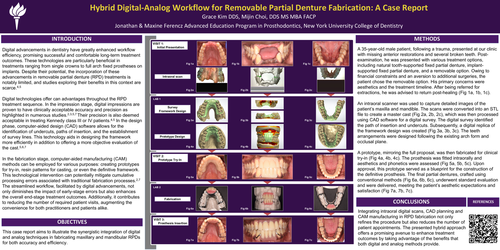
A 35-year-old male patient, following a trauma, presented at our clinic with missing anterior restorations and several broken teeth. Post-examination, he was presented with various treatment options, including natural tooth-supported fixed partial denture, implant-supported fixed partial denture, and a removable option. Owing to financial constraints and an aversion to additional surgeries, the patient chose the removable option. His primary concerns were aesthetics and the treatment timeline. After being referred for extractions, he was advised to return post-healing (Fig 1a, 1b, 1c).
An intraoral scanner was used to capture detailed images of the patient’s maxilla and mandible. The scans were converted into an STL file to create a master cast (Fig 2a, 2b, 2c), which was then processed using CAD software for a digital survey. The digital survey identified the path of insertion and undercuts. Subsequently, a digital replica of the framework design was created (Fig 3a, 3b, 3c). The teeth arrangements were designed following the existing arch form and occlusal plane.
A prototype, mirroring the full proposal, was then fabricated for clinical try-in (Fig 4a, 4b, 4c). The prosthesis was fitted intraorally and aesthetics and phonetics were assessed (Fig 5a, 5b, 5c). Upon approval, this prototype served as a blueprint for the construction of the definitive prosthesis. The final partial dentures, crafted using conventional methods (Fig 6a, 6b, 6c), underwent standard evaluation and were delivered, meeting the patient’s aesthetic expectations and satisfaction (Fig 7a, 7b, 7c).
Conclusions:
Integrating intraoral digital scans, CAD planning and CAM manufacturing in RPD fabrication not only refines the procedure but also reduces the number of patient appointments. The presented hybrid approach offers a promising avenue to enhance treatment outcomes by taking advantage of the benefits that both digital and analog methods provide.