127 posters, 2 topics, 24 sessions, 326 authors, 85 institutions
ePostersLive by SciGen Technologies S.A. All rights reserved.
2023 ACP ANNUAL SESSION
October 25-28 | San Diego, CA

93
Nobel Imperfect?
Poster Presenter
Authors
James Sheffield, Rafael Delgado-Ruiz , Kenneth Kurtz, Tanya Somohano
Affiliations
Part of Topic
Case Presentation
Nobel Imperfect: A Case Study Describing Rescue of an Implant with Damaged Internal Threads
James Clay Sheffield DDS, Rafael Delgado-Ruiz DDS MSc PhD, Kenneth Kurtz DDS FACP, Tanya Somohano-Marquez DMD FACP
Damage to internal threads or the platform of an osseointegrated dental implant can present major challenges to clinicians. The time, cost, and morbidity of surgically removing an integrated implant, placing a new implant, and waiting for osseointegration is a significant hurdle for both patient’s and providers. Prosthodontists should have an array of treatment solutions for many clinical circumstances, including dealing with damaged implants. This case report will outline a technique for rescuing a dental implant with damaged threads.
A 77-year-old male presented to the Post Graduate Prosthodontics Clinic at Stony Brook University with a chief complaint “My maxillary overdenture is rocking forward and backward and it comes out too easily”. The patient has a history of implant failures and peri-implantitis.
The patient presented with three remaining implants (#5,#12, and #10) all with tissue recession and exposure 2-4mm of the implant body. The implants at sites #5 and #12 had locator abutments. The implant at site #10 had no abutment and was not functional. The implant at site #10 has a scalloped platform, damaged internal threads, and lack of prosthetic abutments for overdentures. Therapeutic alternatives included surgical therapy for peri- implantitis, or removal of failing implants, grafting and new implants.
The patient rejected extensive surgeries or new implants and requested to save the existing implants. Proposed and accepted treatment included peri-implant therapy and rescuing #10 by fabricating a custom post and core with a ball attachment adapted to the internal connection and scalloped platform.
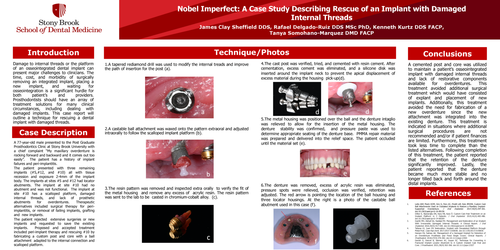
1.A tapered rediamond drill was used to modify the internal treads and improve the path of insertion for the post (a).
2.A castable ball attachment was waxed onto the pattern extraoral and adjusted intraorally to follow the scalloped implant platform (b).
3.The resin pattern was removed and inspected extra orally to verify the fit of the metal housing and remove any excess of acrylic resin. The resin pattern was sent to the lab to be casted in chromium-cobalt alloy. (c).
4.The cast post was verified, tried, and cemented with resin cement. After cementation, excess cement was eliminated, and a silicone disk was inserted around the implant neck to prevent the apical displacement of excess material during the housing pick-up(d).
5.The metal housing was positioned over the ball and the denture intaglio was relieved to allow for the insertion of the metal housing. The denture stability was confirmed, and pressure paste was used to determine appropriate seating of the denture base. PMMA repair material was prepared and delivered into the relief space. The patient occluded until the material set (e).
6.The denture was removed, excess of acrylic resin was eliminated, pressure spots were relieved, occlusion was verified, retention was adjusted. The red arrow is pointing the location of the ball housing and three locator housings. At the right is a photo of the castable ball abutment used in this case (f).
A cemented post and core was utilized to maintain a patient’s osseointegrated implant with damaged internal threads and lack of restorative components available for overdentures. This treatment avoided additional surgical treatment which would have consisted of explant and placement of new implants. Additionally, this treatment avoided the need for fabrication of a new overdenture since the new attachment was integrated into the existing denture. This treatment is indicated in situations where additional surgical procedures are not recommended and/or if patient finances are limited. Furthermore, this treatment took less time to complete than the listed alternatives. Following completion of this treatment, the patient reported that the retention of the denture significantly improved. Lastly, the patient reported that the denture became much more stable and no longer tilled back and forth around the distal implants.