127 posters, 2 topics, 24 sessions, 326 authors, 85 institutions
ePostersLive by SciGen Technologies S.A. All rights reserved.
2023 ACP ANNUAL SESSION
October 25-28 | San Diego, CA

82
Merging Conventional and Digital Workflows to Fabricate an Obturator Prosthesis for a Patient with Limited Mouth Opening
Poster Presenter
Part of Topic
Case Presentation
Merging Conventional and Digital Workflows to Fabricate an Obturator Prosthesis for a Patient with Limited Mouth Opening
INTRODUCTION
Trismus is a common complication following radiation and post-surgical head and neck cancer treatment, which impairs function and affects the fabrication of maxillofacial prosthesis. Additionally, treatment is made more complex by the presence of scar tissue after cancer surgery. The objective of this case report is to determine the accuracy of combining digital and conventional workflows to fabricate a cast and framework of high accuracy and a prosthesis that completely obturates a maxillary defect for a patient with limited mouth opening.
PATIENT OVERVIEW
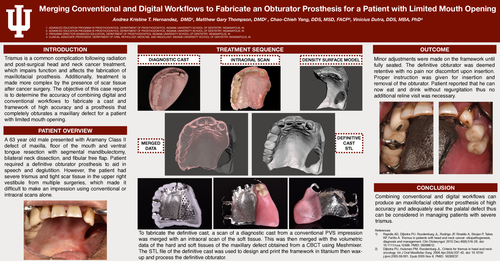
A 63 year old male presented with Aramany Class II defect of maxilla, floor of the mouth and ventral tongue resection with segmental mandibulectomy, bilateral neck dissection, and fibular free flap. Patient required a definitive obturator prosthesis to aid in speech and deglutition. However, the patient had severe trismus and tight scar tissue in the upper right vestibule from multiple surgeries, which made it difficult to make an impression using conventional or intraoral scans alone.
TREATMENT SEQUENCE
To fabricate the definitive cast, a scan of a diagnostic cast from a conventional PVS impression was merged with an intraoral scan of the soft tissue. This was then merged with the volumetric data of the hard and soft tissues of the maxillary defect obtained from a CBCT using Meshmixer. The STL file of the definitive cast was used to design and print the framework in titanium then wax-up and process the definitive obturator.
OUTCOME
Minor adjustments were made on the framework until fully seated. The definitive obturator was deemed retentive with no pain nor discomfort upon insertion. Proper instruction was given for insertion and removal of the obturator. Patient reported that he can now eat and drink withoutregurgitationthus no additional reline visit was necessary.
CONCLUSION
Combining conventional and digital workflows can produce an maxillofacial obturator prosthesis of high accuracy and adequately seal the palatal defect thus can be considered in managing patients with severe trismus.
REFERENCES
- Rapidis AD, Dijkstra PU, Roodenburg JL, Rodrigo JP, Rinaldo A, Strojan P, Takes RP, Ferlito A. Trismus in patients with head and neck cancer: etiopathogenesis, diagnosis and management. Clin Otolaryngol. 2015 Dec;40(6):516-26. doi: 10.1111/coa.12488. PMID: 26098612.
- Dijkstra PU, Huisman PM, Roodenburg JL. Criteria for trismus in head and neck oncology. Int J Oral Maxillofac Surg. 2006 Apr;35(4):337-42. doi: 10.1016/j.ijom.2005.08.001. Epub 2005 Nov 8. PMID: 16280237.