127 posters, 2 topics, 24 sessions, 326 authors, 85 institutions
ePostersLive by SciGen Technologies S.A. All rights reserved.
2023 ACP ANNUAL SESSION
October 25-28 | San Diego, CA
69
Surgical and Prosthetic Rehabilitation of Siblings with Witkop’s Tooth and Nail Syndrome Using Zygomatic Implants: Familial Case Series of Three Patients with Up to 15-year Follow-up
Poster Presenter
Authors
William Castedo, Kale McMillan, Dane McMillan, Kevin Arce, Thomas Salinas
Affiliations
Part of Topic
Case Presentation
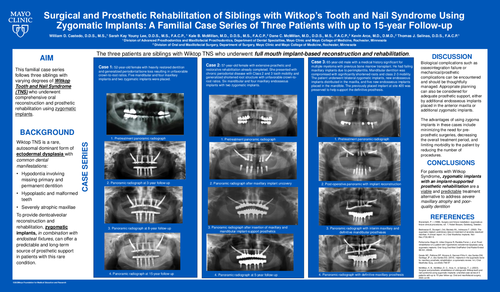
Title: Surgical and Prosthetic Rehabilitation of Siblings with Witkop’s Tooth and Nail Syndrome using Zygomatic Implants: Familial Case Series of Three Patients with Up to 15-year Follow-up Background: Witkop Tooth and Nail Syndrome is a rare, autosomal dominant form of ectodermal dysplasia, which clinically manifests as hypodontia where these patients present with many missing primary and permanent teeth, hypoplastic and malformed dentitions, and develop skeletally atrophic maxillae. While endosseous implants have become a widely accepted mode of treatment for replacing missing single and multiple teeth, these types of implants require large bone volumes to osseointegrate to rehabilitate these patients. Thus, pre-prosthetic surgeries are often necessary in cases where the maxillary alveolus is severely atrophic, such as orthognathic advancement surgery, extensive bone grafting, and sinus floor augmentations, before the placement of endosseous dental implants. Although this treatment sequence has shown promising outcomes, it requires multiple surgical procedures, a prolonged treatment course, and increased patient morbidity risk. However, zygomatic implants are a viable alternative treatment in patients with ectodermal dysplasia that manifest atrophic maxillae. Objective: This familial case series examines three siblings with confirmed diagnoses of varying degrees of Witkop Syndrome, who underwent comprehensive prosthetic rehabilitation with pre-prosthetic surgery using zygomatic implants. Case history/Technical steps: All three patients are siblings with varying presentation ectodermal dysplasia, who underwent complete maxillary and mandibular. edentulation and maxillary rehabilitation utilizing zygomatic implants: Case 1: 52-year-old female with heavily restored dentition and generalized periodontal bone loss with unfavorable crown-to-root ratios. Five mandibular and four maxillary implants and two zygomatic implants were placed. Case 2: 57-year-old female with extensive prosthetic and restorative rehabilitation already completed. She presented with chronic periodontal disease with Class 2 and 3 tooth mobility and generalized shortened root structure with unfavorable crown-to-root ratios. Six mandibular endosseous implants (four interforaminal and two posteriorly) and four endosseous implants with two zygomatic implants. Case 3: 65-year-old male with a medical history significant for multiple myeloma with previous bone marrow transplant, at initial presentation, stable on daratumumab, pomalidomide, and dexamethasone. He underwent extensive dental rehabilitation: maxillary implant-retained, metalreinforced overdenture. He presented clinically with insufficient retention of his maxillary overdenture with compromised function and peri-implantitis of the three remaining maxillary implants. Mandibular dentition had a shortened dental arch with radiographically significant shortened roots on his posterior teeth with class 2 and 3 mobility. The patient underwent bilateral zygomatic implants, three endosseous implants in the anterior maxilla, an additional single endosseous implant placed in the right posterior maxilla, and five interforaminal endosseous implants placed in the mandible. Previously placed implant at site #20 would be preserved to help support the definitive prosthesis. Results: These cases present a 15-year follow-up period, with an 85.7% survival rate for zygomatic implants with minor prosthetic complications noted. Conclusion: Witkop TNS has hereditary hypo-oligodontia, where partial and complete edentulation with full mouth rehabilitation is needed or desired. Full mouth rehabilitation with dental implants and fixed, full-arch prostheses is a viable treatment option. Ideally, it requires close interdisciplinary management of at least an OMS and prosthodontist with acceptable long-term outcomes can be achieved.