127 posters, 2 topics, 24 sessions, 326 authors, 85 institutions
ePostersLive by SciGen Technologies S.A. All rights reserved.
2023 ACP ANNUAL SESSION
October 25-28 | San Diego, CA

67
A CAD/CAM Approach to Treatment of an Edentulous Patient with Microstomia
Poster Presenter
Authors
Affiliations
Part of Topic
Case Presentation
Introduction:
Microstomia is the term used to describe a reduction in the size of the oral aperture that is severe enough to compromise quality of life, nutrition, and cosmesis. Most cases are acquired from trauma, or accidental electric, thermal, or chemical burns (NIH). Being edentulous for years without any prosthesis, this patient suffers from microstomia. An adult stock tray could not be inserted into patients oral cavity, neither the intraoral scanner head. The objective was to digitally fabricate a custom tray that would accomplish the goal of making an accurate final impression for a patient that presents with microstomia.
Case Report:
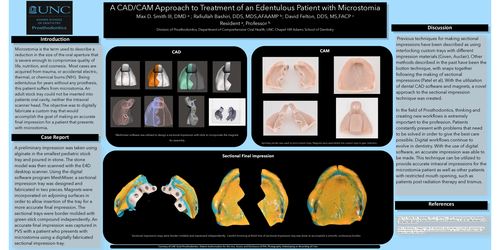
A preliminary impression was taken using alginate in the smallest pediatric stock tray and poured in stone. The stone model was then scanned with the E4D desktop scanner. Using the digital software program MeshMixer, a sectional impression tray was designed and fabricated in two pieces. Magnets were incorporated on adjoining surfaces in order to allow insertion of the tray for a more accurate final impression. The sectional trays were border molded with green stick compound independently. An accurate final impression was captured in PVS with a patient who presents with microstomia using a digitally fabricated sectional impression tray.
Discussion:
Previous techniques for making sectional impressions have been described as using interlocking custom trays with different impression materials (Given, Auclair). Other methods described in the past have been the button technique, with snaps together following the making of sectional impressions (Patel et al). With the utilization of dental CAD software and magnets, a novel approach to the sectional impression technique was created. In the field of Prosthodontics, thinking and creating new workflows is extremely important to the profession. Patients constantly present with problems that need to be solved in order to give the best care possible. Digital workflows continue to evolve in dentistry. With the use of digital software, an accurate impression was able to be made. This technique can be utilized to provide accurate intraoral impressions for the microstomia patient as well as other patient with restricted mouth opening, such as patients post radiation therapy and trismus.