127 posters, 2 topics, 24 sessions, 326 authors, 85 institutions
ePostersLive by SciGen Technologies S.A. All rights reserved.
2023 ACP ANNUAL SESSION
October 25-28 | San Diego, CA

66
Three-Visit Digital Workflow for Management of Adolescence Amelogenesis Imperfecta: a case report
Poster Presenter
Authors
Affiliations
Part of Topic
Case Presentation
Three-Visit Digital Workflow for Management of Adolescence Amelogenesis Imperfecta: A Case Report
* INTRODUCTION
Amelogenesis imperfecta (AI) is a disorder defined by disrupted enamel formation, primarily stemming from genetic factors.1,2Treating individuals with AI is notably challenging because many cases of AI are associated with dental and skeletal anomalies, causing increased dental sensitivity.3, 4, 5
* OBJECTIVES
This clinical case report focuses on the two-visit rehabilitation process using digital workflow for a 14-year-old female patient diagnosed with hypoplastic AI, genetic mutation not hereditary.6,7,8,9 The patient presented with severe dental sensitivity, discolored teeth, anterior open bite, skeletal class III malocclusion, and absence of mutually protected occlusion.
Effective treatment of AI demands attention to both functional and aesthetic needs.10,11,12,,13Additionally, early intervention and sequential treatment phase is essential for promoting balanced maxillofacial growth, and proper interdisciplinary care while reducing discomfort.14,15,16,17
This presentation show diagnostic treatment phase and utilization of digital workflow and carefully sequenced clinical care that can significantly improve the quality of life for AI patients during their formative years.
* METHODS
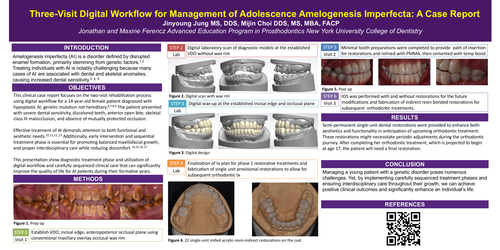
1. Establish VDO, incisal edge, anteroposterior occlusal plane using conventional maxillary overlay occlusal wax rim
2. Digital laboratory scan of diagnostic models at the established VDO without wax rim
3. Digital wax-up at the established incisal edge and occlusal plane
4. Finalization of tx plan for phase 1 restorative treatments and fabrication of single unit provisional restorations to allow for subsequent orthodontic tx
5. Minimal tooth preparations were completed to provide path of insertion for restorations and relined with PMMA, then cemented with temp bond.
6. IOS was performed with and without restorations for the future modifications and fabrication of indirect resin bonded restorations for subsequent orthodontic treatments.
* RESULTS
Semi-permanent single-unit dental restorations were provided to enhance both aesthetics and functionality in anticipation of upcoming orthodontic treatment. These restorations might necessitate periodic adjustments during the orthodontic journey. After completing her orthodontic treatment, which is projected to begin at age 17, the patient will need a final restoration.
* CONCLUSION
Managing a young patient with a genetic disorder poses numerous challenges. Yet, by implementing carefully sequenced treatment phases and ensuring interdisciplinary care throughout their growth, we can achieve positive clinical outcomes and significantly enhance an individual’s life.