127 posters, 2 topics, 24 sessions, 326 authors, 85 institutions
ePostersLive by SciGen Technologies S.A. All rights reserved.
2023 ACP ANNUAL SESSION
October 25-28 | San Diego, CA

58
Maxillary Rehabilitation for a patient with cleft palate: Achieving Aesthetic and Functional Equilibrium in Complex Malocclusion
Poster Presenter
Authors
Affiliations
Part of Topic
Case Presentation
Introduction:
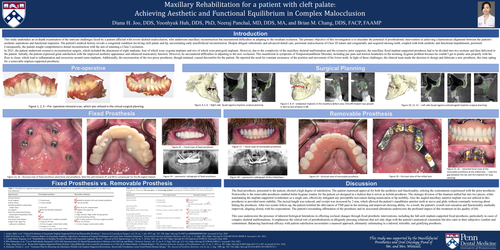
This study undertakes an in-depth examination of the intricate challenges faced by a patient afflicted with severe skeletal malocclusion, who underwent maxillary reconstruction but encountered difficulties in adapting to the resultant occlusion. The primary objective of this investigation is to elucidate the potential of prosthodontic intervention in achieving a harmonious alignment between the patient's aesthetic aspirations and functional requisites. The patient's medical history reveals a congenital condition involving cleft palate and lip, necessitating early maxillofacial reconstruction. Despite diligent orthodontic and advanced dental care, persistent malocclusion of Class III nature and congenitally and acquired missing teeth, coupled with both aesthetic and functional impediments, persisted. Consequently, the patient sought comprehensive dental reconstruction with the aim of attaining a Class I occlusion.
In 2021, the patient underwent extensive reconstruction surgery, which included the placement of eight implants, four of which were zygoma implants and two of which were pterygoid implants. However, due to the complexity of the maxillary skeletal malformation and the extensive prior surgeries, the maxillary fixed implant-supported prosthesis had to be divided into two sections and then delivered to the patient. Initially, the patient expressed great satisfaction with the improved aesthetic appearance and enhanced masticatory function. However, he encountered difficulties in adjusting to the new occlusion. This manifested in symptoms of Temporomandibular Disorder, including jaw pain and tension headaches in the morning, hygiene problem because he couldn’t get to pontic area properly with his floss to clean, which lead to inflammation and recessions around some implants. Additionally, the micromotion of the two-piece prosthesis, though minimal, caused discomfort for the patient. He reported the need for constant awareness of the position and movement of his lower teeth. In light of these challenges, the clinical team made the decision to design and fabricate a new prosthesis, this time opting for a removable implant-supported prosthesis.
Discussion
The final prosthesis, presented to the patient, elicited a high degree of satisfaction. The patient expressed approval for both the aesthetics and functionality, echoing the contentment experienced with the prior prosthesis. Noteworthy is the removable prosthesis enabled better hygiene routine for the patient yet designed in a fashion that it serves as hybrid prosthesis. The strategic division of the titanium milled bar into two pieces, while maintaining the implant-supported overdenture as a single unit, effectively mitigated any perceptible movement during mastication or lip mobility. Also the angled maxillary anterior implant was not utilized in this prosthesis to provided more stability. The incisal length was reduced, and overjet was increased by 2 mm, which allowed the patient’s mandibular anterior teeth to move and glide without constantly worrying about hitting the prosthesis. After two-weeks follow-up, the patient testified the alleviation of TMJ pain in the morning and improved chewing ability. As a result, the patient's overall oral sensation and functionality markedly improved, aligning closely with his expectations. The patient's resounding affirmation of the prosthesis and its associated alterations underscores the profound impact of this treatment on his quality of life.
This case underscores the presence of inherent biological limitations in effecting occlusal changes through fixed prosthetic interventions, including the full-arch implant-supported fixed prosthesis, particularly in cases of complex skeletal malformations. It emphasizes the critical role of prosthodontists in diligently pursuing solutions that not only align with the patient's anatomical constraints but also cater to their subjective comfort and contentment. Balancing functional efficacy with patient satisfaction necessitates a nuanced approach, ultimately culminating in a tailored, tolerable, and gratifying prosthesis.