127 posters, 2 topics, 24 sessions, 326 authors, 85 institutions
ePostersLive by SciGen Technologies S.A. All rights reserved.
2023 ACP ANNUAL SESSION
October 25-28 | San Diego, CA

41
Digital Workflow for Retrofitting a Zirconia Survey Crown with Prototype Try-In
Poster Presenter
Part of Topic
Case Presentation
Introduction
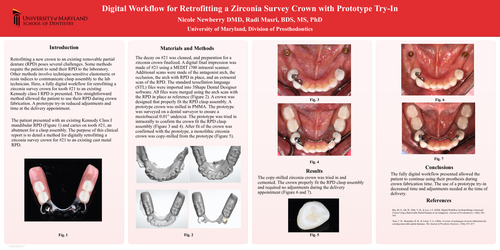
Retrofitting a new crown to an existing removable partial denture (RPD) poses several challenges. Some methods require the patient to send their RPD to the laboratory. Other methods involve technique-sensitive elastomeric or resin indices to communicate clasp assembly to the lab technician. Here, a fully digital workflow for retrofitting a zirconia survey crown for tooth #21 to an existing Kennedy class I RPD is presented. This straightforward method allowed the patient to use their RPD during crown fabrication. A prototype try-in reduced adjustments and time at the delivery appointment.
The patient presented with an existing Kennedy Class I mandibular RPD (Figure 1) and caries on tooth #21, an abutment for a clasp assembly. The purpose of this clinical report is to detail a method for digitally retrofitting a zirconia survey crown for #21 to an existing cast metal RPD.
Materials and Methods
The decay on #21 was cleaned, and preparation for a zirconia crown finalized. A digital final impression was made of #21 using a MEDIT i700 intraoral scanner. Additional scans were made of the antagonist arch, the occlusion, the arch with RPD in place, and an extraoral scan of the RPD. The standard tessellation language (STL) files were imported into 3Shape Dental Designer software. All files were merged using the arch scan with the RPD in place as reference (Figure 2). A crown was designed that properly fit the RPD clasp assembly. A prototype crown was milled in PMMA. The prototype was surveyed on a dental surveyor to ensure a mesiobuccal 0.01” undercut. The prototype was tried in intraorally to confirm the crown fit the RPD clasp assembly (Figure 3 and 4). After fit of the crown was confirmed with the prototype, a monolithic zirconia crown was copy-milled from the prototype (Figure 5).
Results
The copy-milled zirconia crown was tried in and cemented. The crown properly fit the RPD clasp assembly and required no adjustments during the delivery appointment (Figure 6 and 7).
Conclusions
The fully digital workflow presented allowed the patient to continue using their prosthesis during crown fabrication time. The use of a prototype try-in decreased time and adjustments needed at the time of delivery.