127 posters, 2 topics, 24 sessions, 326 authors, 85 institutions
ePostersLive by SciGen Technologies S.A. All rights reserved.
2023 ACP ANNUAL SESSION
October 25-28 | San Diego, CA

31
Prosthetic-surgical-prosthetic approach for treating esthetically compromised single dental implant
Poster Presenter
Authors
Andreas Onisiforou, Abdusalam Alrmali, Jessica Latimer, Alhusssan Gnao, Christiana Onisiforou, Berna Saglik
Affiliations
Part of Topic
Case Presentation
Prosthetic-surgical-prosthetic approach for treating an esthetically compromised single dental implant.
Introduction:
Managing esthetic peri-implant complications can be challenging, with a prevalence of up to 64% among immediate implants. Historically, the primary focus was on bone quality for long-term success. Today, experts emphasize the importance of considering the peri-implant soft tissue component, not only from a biological perspective but also from an aesthetic standpoint.
Objective:
This report aims to present an appropriate treatment approach for compromised esthetics associated with dental implants involving the combined loss of peri-implant papillae and loss of periodontal attachment on adjacent teeth.
Case presentation:
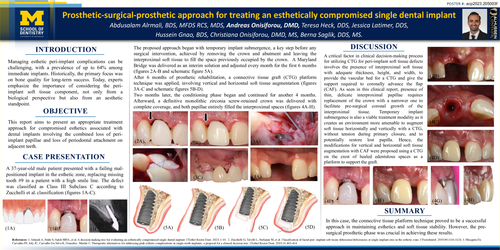
A 37-year-old male patient presented with a failing mal-positioned implant in the esthetic zone, replacing missing tooth #9 in a patient with a high smile line. The defect was classified as Class III Subclass C according to Zucchelli et al. classification (figures 1A-C).
The proposed approach began with temporary implant submergence, a key step before any surgical intervention, achieved by removing the crown and abutment and leaving the interproximal soft tissue to fill the space previously occupied by the crown. A Maryland Bridge was delivered as an interim solution and adjusted every month for the first 6 months (figures 2A-B and schematic figure 5A).
After 6 months of prosthetic rehabilitation, a connective tissue graft (CTG) platform technique was applied, involving vertical and horizontal soft tissue augmentation (figures 3A-C and schematic figures 5B-D).
Two months later, the conditioning phase began and continued for another 4 months. Afterward, a definitive monolithic zirconia screw-retained crown was delivered with complete coverage, and both papillae entirely filled the interproximal spaces (figures 4A-H).
Discussion:
A critical factor in clinical decision-making process for utilizing CTG for peri-implant soft tissue defects involves the presence of interproximal soft tissue with adequate thickness, height, and width, to provide the vascular bed for a CTG and give the support required to coronally advance the flap (CAF). As seen in this clinical report, presence of thin, delicate interproximal papillae requires replacement of the crown with a narrower one to facilitate pre-surgical coronal growth of the interproximal tissue. Temporary implant submergence is also a viable treatment modality as it creates an environment more amenable to augment soft tissue horizontally and vertically with a CTG, without tension during primary closure, and to potentially restore lost papilla. Hence, the modifications for vertical and horizontal soft tissue augmentation with CAF were proposed using a CTG on the crest of healed edentulous spaces as a platform to support the graft.
Summary:
In this case, the connective tissue platform technique proved to be a successful approach in maintaining esthetics and soft tissue stability. However, the pre-surgical prosthetic phase was crucial in achieving these results.