127 posters, 2 topics, 24 sessions, 326 authors, 85 institutions
ePostersLive by SciGen Technologies S.A. All rights reserved.
2023 ACP ANNUAL SESSION
October 25-28 | San Diego, CA

19
Zygomatic Implant Supported Bar Overdenture for a patient with Atrophic Maxilla: A Case Report
Poster Presenter
Authors
Affiliations
Part of Topic
Case Presentation
Zygomatic Implant-Supported Bar Overdenture for a patient with Atrophic Maxilla: A Case Report
Himanshi Aggarwal1, Wen Chou Wu 2, Chin-Chuan Fu 1
1UAB School of Dentistry; 2Columbia University
Objective: To present a case of 68-year-old female with atrophic maxilla who was successfully rehabilitated with quad-zygoma implant-supported bar overdenture.
Introduction:
Case Presentation:
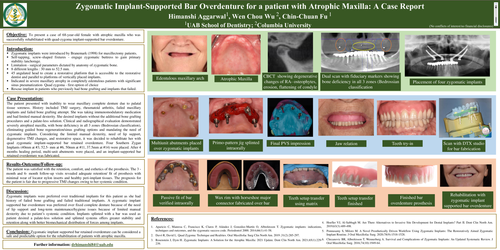
The patient presented with inability to wear maxillary complete denture due to palatal tissue soreness. History included TMJ surgery, rheumatoid arthritis, failed maxillary implants and failed bone grafting attempt. She was taking immunomodulatory medication and had limited manual dexterity. She desired implants without the additional bone grafting procedures and a palate-less solution. Clinical and radiographical evaluation demonstrated severely atrophied maxilla, with bone deficiency in all 3 zones (Bedrossian classification), eliminating guided bone regeneration/sinus grafting options and mandating the need of zygomatic implants. Considering the limited manual dexterity, need of lip support, degenerative TMJ changes, and restorative space, it was decided to rehabilitate her with quad zygomatic implant-supported bar retained overdenture. Four Southern Zygan Implants (40mm at #3, 52.5- mm at #6, 50mm at #11, 37.5mm at #14) were placed. After 4 months healing period, multi-unit abutments were placed, and an implant-supported bar retained overdenture was fabricated.
Results-Outcome/Follow-up:
The patient was satisfied with the retention, comfort, and esthetics of the prosthesis. The 3 -month and 6- month follow-up visits revealed adequate retention/ fit of prosthesis with minimal wear of locator nylon inserts and healthy peri-implant tissues. The prognosis for the patient is fair due to progressive TMJ changes owing to her systemic condition.
Discussion:
Zygomatic implants were preferred over traditional implants for this patient as she had history of failed bone grafting and failed traditional implants. A zygomatic implant supported bar overdenture was preferred over fixed complete denture because of the need of lip support and long-term maintenance/hygiene issues because of limited manual dexterity due to patient’s systemic condition. Implants splinted with a bar was used as patient desired a palate-less solution and splinted systems offers greater stability and retention along with better biomechanical distribution of forces among implants.
Conclusion:Zygomatic implant supported bar retained overdenture can be considered a safe and predictable option for the rehabilitation of patients with atrophic maxilla.