127 posters, 2 topics, 24 sessions, 326 authors, 85 institutions
ePostersLive by SciGen Technologies S.A. All rights reserved.
2023 ACP ANNUAL SESSION
October 25-28 | San Diego, CA

186
Prosthetic considerations in decision making for identifying and utilizing existing dental implants. A case report.
Poster Presenter
Authors
Affiliations
Part of Topic
Case Presentation
Decision Making for Identification and Utilization of Existing Implants and Replacement of Unsatisfactory Full-arch Restoration. A Case Report.
Jose Briceno, BDS ; Niranjan Joshi, MDS, MS, FACP ; Jack Piermatti, DMD, FACP. Nova Southeastern University
Introduction
Patients often present with osseointegrated implants which were placed by previous dental providers. In most scenarios, patients are not able to recall the implant brand or size information. Thus, clinicians must rely on their expertise and ability to figure out the brand and diameter of the implants. As clinicians, we have two ways to determine the type of implant. One way is comparing the x-rays we have with online databases 1,2. Another option is to insert different screwdrivers into the implant until we find a compatible one to narrow down our possible options. Both methods will help us to corroborate the implant traits needed to restore them. A case presentation which used both methods to determine the implant brand and diameter was used.
Purpose/Aim
The current study aims to determine a workflow on restoring previously placed implants comparing patient radiographs with radiographs from a website and them inserting different screwdrivers into implants until we find a compatible one to narrow down the options.
Materials & Methods
A full mouth radiographic series was taken on a patient with a failing FULL-ARCH implant-supported restoration. Radiographs were compared to radiographs on an online database (whatimplantisthat.com). After analyzing the radiographs from the patient and the images from the website, possibilities were narrowed down (interface, platform, threads, body, apex shape were analyzed) 1,2. To double check the implant brands a universal set of screw drivers was used to unscrew the failing FP1. A compatible screwdriver was used on each implant set with the brand of implant that matched better radiographically. All drivers coincided with the expected brand.
Sequencing
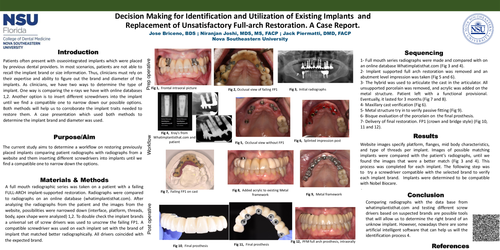
1- Full mouth series radiographs were made and compared with on an online database Whatimplatisthat.com (Fig 3 and 4).
2- Implant supported full arch restoration was removed and an abutment level impression was taken (Fig 5 and 6).
3- The hybrid was used to articulate the cast in the articulator. All unsupported porcelain was removed, and acrylic was added on the metal structure. Patient left with a functional provisional. Eventually, it lasted for 3 months (Fig 7 and 8).
4- Maxillary cast verification (Fig 6).
5- Metal structure try in to verify passive fitting (Fig 9).
6- Bisque evaluation of the porcelain on the final prosthesis.
7- Delivery of final restoration. FP1 (crown and bridge style) (Fig 10, 11 and 12).
Results
Website images specify platform, flanges, mid body characteristics, and type of threads per implant. Images of possible matching implants were compared with the patient’s radiographs, until we found the images that were a better match (Fig 3 and 4). This process was completed for each implant. The following step was to try a screwdriver compatible with the selected brand to verify each implant brand. Implants were determined to be compatible with Nobel Biocare.
Conclusion
Comparing radiographs with the data base from whatimplantisthat.com and testing different screw drivers based on suspected brands are possible tools that will allow us to determine the right brand of an unknow implant. However, nowadays there are some artificial intelligent software that can help us will the identification process 4.
References