127 posters, 2 topics, 24 sessions, 326 authors, 85 institutions
ePostersLive by SciGen Technologies S.A. All rights reserved.
2023 ACP ANNUAL SESSION
October 25-28 | San Diego, CA

174
Full-arch Intraoral Scanning for Implant Supported Prosthesis with Horizontal Scan Gauges
Poster Presenter
Part of Topic
Case Presentation
Full-Arch Intraoral Scanning with Horizontal Scan can Gauges : A Case Report
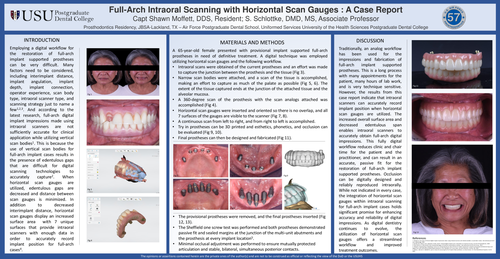
Employing a digital workflow for the restoration of full-arch implant supported prostheses can be very difficult. Many factors need to be considered, including interimplant distance, implant angulation, implant depth, implant connection, operator experience, scan body type, intraoral scanner type, and scanning strategy just to name a few1,2,3. And according to the latest research, full-arch digital implant impressions made using intraoral scanners are not sufficiently accurate for clinical application while utilizing vertical scan bodies1. This is because the use of vertical scan bodies for full-arch implant cases results in the presence of edentulous gaps that are difficult for digital scanning technologies to accurately capture2. When horizontal scan gauges are utilized, edentulous gaps are decreased and distance between scan gauges is minimized. In addition to decreased interimplant distance, horizontal scan gauges display an increased surface area with 7 unique surfaces that provide intraoral scanners with enough data in order to accurately record implant position for full-arch cases4.
A 65-year-old female presented with provisional implant supported full-arch prostheses in need of definitive treatment. A digital technique was employed utilizing horizontal scan gauges and the following workflow.
• Intraoral scans were obtained of the current prostheses and an effort was made to capture the junction between the prosthesis and the tissue (Fig 3).
• Narrow scan bodies were attached, and a scan of the tissue is accomplished, making an effort to capture as much of the palate as possible (Fig 5, 6). The extent of the tissue captured ends at the junction of the attached tissue and the alveolar mucosa.
• A 360-degree scan of the prosthesis with the scan analogs attached was accomplished (Fig 4).
• Horizontal scan gauges were inserted and oriented so there is no overlap, and all 7 surfaces of the gauges are visible to the scanner (Fig 7, 8).
• A continuous scan from left to right, and from right to left is accomplished.
• Try in prostheses can be 3D printed and esthetics, phonetics, and occlusion can be evaluated (Fig 9, 10).
• Final prostheses can then be designed and fabricated (Fig 11).
• The provisional prostheses were removed, and the final prostheses inserted (Fig 12, 13).
• The Sheffield one screw test was performed and both prostheses demonstrated passive fit and sealed margins at the junction of the multi-unit abutments and the prosthesis at every implant location5.
• Minimal occlusal adjustment was performed to ensure mutually protected articulation and stable, bilateral, simultaneous posterior contacts.
Traditionally, an analog workflow has been used for the impressions and fabrication of full-arch implant supported prostheses. This is a long process with many appointments for the patient, many hours of lab work, and is very technique sensitive. However, the results from this case report indicate that intraoral scanners can accurately record implant position when horizontal scan gauges are utilized. The increased overall surface area and decreased edentulous span enables intraoral scanners to accurately obtain full-arch digital impressions. This fully digital workflow reduces clinic and chair time for the patient and the practitioner, and can result in an accurate, passive fit for the restoration of full-arch implant supported prostheses. Occlusion can be digitally designed and reliably reproduced intraorally. While not indicated in every case, the integration of horizontal scan gauges within intraoral scanning for full-arch implant cases holds significant promise for enhancing accuracy and reliability of digital impressions. As digital dentistry continues to evolve, the utilization of horizontal scan gauges offers a streamlined workflow and improved treatment outcomes.