127 posters, 2 topics, 24 sessions, 326 authors, 85 institutions
ePostersLive by SciGen Technologies S.A. All rights reserved.
2023 ACP ANNUAL SESSION
October 25-28 | San Diego, CA

167
A Novel Technique for Applying Wrought Wire Clasps to a Printed Interim Partial Denture
Poster Presenter
Authors
Affiliations
DUMMY, DUMMY, University of Maryland School of Dental Medicine
Part of Topic
Case Presentation
A Novel Technique for Applying Wrought Wire Clasps to a Printed Interim Partial Denture
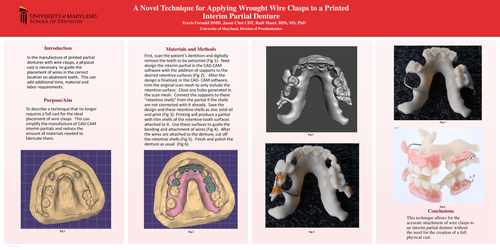
In the manufacture of printed partial dentures with wire clasps, a physical cast is necessary to guide the placement of wires in the correct location on abutment teeth. This can add additional time, material and labor requirements.
To describe a technique that no longer requires a full cast for the ideal placement of wire clasps. This can simplify the manufacture of CAD-CAM interim partials and reduce the amount of materials needed to fabricate them.
First, scan the patient’s dentition and digitally remove the teeth to be extracted (Fig 1). Next design the interim partial in the CAD-CAM software with the addition of supports to the desired retentive surfaces (Fig 2). After the design is finalized, in the CAD- CAM software, trim the original scan mesh to only include the retentive surface. Close any holes generated in the scan mesh. Connect the supports to these “retentive shells” from the partial if the shells are not connected with it already. Save the design and these retentive shells as one solid stl and print (Fig 3). Printing will produce a partial with thin shells of the retentive tooth surfaces attached to it. Use these surfaces to guide the bending and attachment of wires (Fig 4). After the wires are attached to the denture, cut off the retentive shells (Fig 5). Finish and polish the denture as usual (Fig 6).
This technique allows for the accurate attachment of wire clasps to an interim partial denture without the need for the creation of a full physical cast.