127 posters, 2 topics, 24 sessions, 326 authors, 85 institutions
ePostersLive by SciGen Technologies S.A. All rights reserved.
2023 ACP ANNUAL SESSION
October 25-28 | San Diego, CA

163
Dental Implant Planning versus Maxillary Sinus Aspergillosis: A Case Report.
Poster Presenter
Authors
Affiliations
Part of Topic
Case Presentation
Case Report
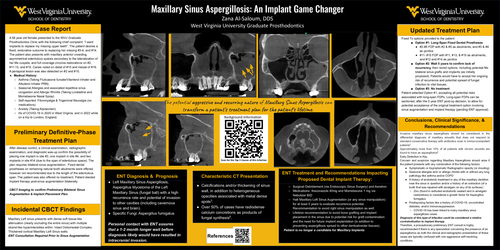
A 58 year old female presented to the WVU Graduate Prosthodontics Clinic with the following chief complaint: “I want implants to replace my missing upper teeth”. The patient desires a fixed, restorative outcome to replacing her missing #3-4, and #14. The patient also presents with maxillary anterior crowding, asymmetrical edentulous spaces secondary to the lateralization of her Mx cuspids, and full coverage zirconia restorations on #2, #11-13, and #15. Caries noted on distal of #15 and mesial of #16. A periapical lesion was also detected on #2 and #15.
-
Medical History:
-
Asthma (Taking Fluticasone furoate/Vilanterol Inhaler and Albuterol Inhaler PRN)
-
Seasonal Allergies and associated repetitive sinus congestion and Allergic Rhinitis (Taking Loratadine and Mometasone Nasal Spray)
-
Self-reported Fibromyalgia & Trigeminal Neuralgia (no medications)
-
Anxiety (Taking Alprazolam)
-
Hx of COVID-19 in 2020 in West Virginia, and in 2022 while on a trip to London, England.
Preliminary Definitive-Phase Treatment Plan
After disease control, a clinical examination, radiographic examination, and diagnostic wax-up confirm the possibility of placing one implant in site #3, one implant in site #4, and two implants in site #14 (due to the span of edentulous space). The plan requires bilateral sinus augmentation. Fixed dental prostheses on remaining natural tooth abutments were offered, however not recommended due to the length of the edentulous span. The patient was also offered no treatment. Patient elected implant therapy post-sinus augmentation bilaterally.
CBCT Imaging to confirm Preliminary Bilateral Sinus Augmentation & Implant Placement Plan.
Incidental CBCT Findings
Maxillary Left sinus presents with dense soft tissue-like attenuation (nearly occluding the entire sinus) with multiple strand-like hyperintensities within. Intact Ostiomeatal Complex. Thickened cortical Maxillary Left Sinus walls.
ENT Consultation Required Prior to Sinus Augmentation
ENT Diagnosis & Prognosis
-
Left Maxillary Sinus Aspergillosis, Aspergillus Mycetoma of the Left Maxillary Sinus (fungal ball) with a high recurrence rate and potential of invasion to other cavities (including cavernous sinus and brain).
-
Specific Fungi: Aspergillus fumigatus
Personal contact with ENT assures that a 1-2 month longer wait before diagnosis likely would have resulted in intracranial invasion.
Characteristic CT Presentation
-
Calcifications and/or thickening of sinus wall, in addition to heterogeneous opacities associated with metal dense spots3.
-
Over 50% of cases have radiodense calcium concretions as products of fungal synthesis6.
ENT Treatment and Recommendations Impacting Proposed Dental Implant Therapy:
-
Surgical Debridement (via Endoscopic Sinus Surgery) and Aeration
-
Medications: Itraconazole 40mg and Mometasone 1 mg via Nebulizer BID
-
Halt Maxillary Left Sinus Augmentation (or any sinus manipulation) for at least 5 years to evaluate recurrence potential. Recommendation to avoid right sinus manipulation as well.
-
Lifetime recommendation to avoid bone grafting and implant placement in the sinus due to potential risk for graft contamination and the need for future implant explantation (in addition to preventing aspergillosis spread to other dentoalveolar tissues).
Patient is no longer a candidate for Maxillary Implants
Updated Treatment Plan
Fixed Tx options provided to the patient
-
Option #1: Long-Span Fixed Dental Prostheses
-
#2-#5 FDP with #2 & #5 as abutments, and #3 & #4 as pontics
-
#11- #15 FDP with #11, #13, & #15 as abutments, and #12 and #14 as pontics
-
Option #2: Wait 5 years to confirm lack of recurrency, then revisit options, including potential Mx bilateral sinus grafts and implants (as initially proposed). Patients would have to accept her ongoing risk of recurrence and potential spread of fungal infection to vital tissues.
-
Option #3: No treatment
Patient selected Option #1, accepting all potential risks associated with long-span FDPs. Long-span FDPs can be sectioned, after the 5 year ENT post-op decision, to allow for potential acceptance of the original treatment option involving sinus augmentation and implant therapy (pending ENT approval).
Conclusions, Clinical Significance, & Recommendations
Invasive maxillary sinus aspergillosis should be considered in the differential diagnosis of maxillary sinusitis that does not respond to standard conservative therapy with antibiotics even in immunocompetent patients2.
Approximately more than 10% of all patients with chronic sinusitis are found to have an aspergilloma5.
Early Detection is Key.
Concern and suspicion regarding Maxillary Aspergillosis should arise if the patient presents with any combination of the following factors:
-
Symptomatic or Asymptomatic Radiographic opacity (or clouding)
-
Seasonal allergies and/ or allergic rhinitis with or without any lung pathology like asthma and/or COPD
-
A history of endodontic treatment in any of the maxillary dentition near the sinus in question and/or a history of an extraction (of a tooth that was repaired with amalgam on any of its surfaces)
-
Zinc (found in extruded endodontic sealant and in amalgam restorations) is considered a growth factor for Aspergillus fumigatus
-
Predisposing factors like a history of COVID-19, uncontrolled diabetes, and/or immunosuppression
-
COVID-19 has been linked to many maxillary sinus aspergillosis cases
Diagnosis of this type of infection could be considered a relative contraindication to implant therapy.
Therefore, a precautionary preliminary ENT consult is highly recommended if there is any speculation concerning the presence of an aspergilloma–as both the clinical and radiographic presentation of these cases are typically confused with non-aggressive self-resolving conditions.