127 posters, 2 topics, 24 sessions, 326 authors, 85 institutions
ePostersLive by SciGen Technologies S.A. All rights reserved.
2023 ACP ANNUAL SESSION
October 25-28 | San Diego, CA

152
A novel technique utilizing a combined restorative and surgical approach to treat a Class III papillary recession: a case report
Poster Presenter
Part of Topic
Case Presentation
Introduction
Treatment and prevention of interproximal recessions after periodontal therapy has been a challenging goal for years, given the esthetic concerns that might cause (1). The resulting black triangles are highly unesthetic and are a frequent concern from patients (2).
The presence of an interdental papilla is dictated by various factors, among which the distance between the contact point and the bone crest plays an important role. Specifically, Tarnow et al. observed that if the same distance is 5 mm or less, the papilla was present 95% of the times (3).
Traditional treatment options include orthodontic, restorative, surgical and combined approaches (4). However most of the published research on these techniques consist of case reports or case series, supporting a low level of evidence and unpredictability of acceptable results (5, 6).
Case Report
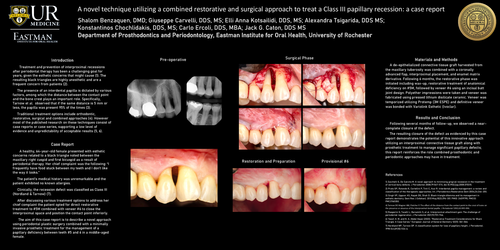
A healthy, 64-year-old female presented with esthetic concerns related to a black triangle noted between the maxillary right cuspid and first bicuspid as a result of periodontal therapy. Her chief complaint was the following: “I frequently have food stuck between my teeth and I don’t like the way it looks.”
The patient’s medical history was unremarkable and the patient exhibited no known allergies.
Clinically, the recession defect was classified as Class III (Nordland & Tarnow) (7).
After discussing various treatment options to address her chief complaint the patient opted for direct restorative treatment to #5M combined with veneer #6 to close the interproximal space and position the contact point inferiorly.
The aim of this case report is to describe a novel approach using periodontal plastic surgery combined with a minimally invasive prosthetic treatment for the management of a papillary deficiency between teeth #5 and 6 in a middle-aged female.
Materials and Methods
A de-epithelialized connective tissue graft harvested from the maxillary tuberosity was combined with a coronally advanced flap, interproximal placement, and enamel matrix derivative. Following 6 months, the restorative phase was initiated including wax-up, restorative treatment of anatomical deficiency on #5M, followed by veneer #6 using an incisal butt joint design. Polyether impressions were taken and veneer was fabricated using pressed lithium disilicate ceramic. Veneer was temporized utilizing Protemp (3M ESPE) and definitive veneer was bonded with Variolink Esthetic (Ivoclar).
Results and Conclusion
Following several months of follow-up, we observed a near-complete closure of the defect.
The resulting closure of the defect as evidenced by this case report demonstrates the potential of this innovative approach utilizing an interproximal connective tissue graft along with prosthetic treatment to manage significant papillary defects; this report reinforces the role combined prosthodontic and periodontic approaches may have in treatment.
References
1) Zucchelli G, De Sanctis M. A novel approach to minimizing gingival recession in the treatment of vertical bony defects. J Periodontol 2008;79:567-574. doi:10.1902/jop.2008.070315.
2) Prato GP, Rotundo R, Cortellini P, Tinti C, Azzi R. Interdental papilla management: a review and classification of the therapeutic approaches. Int J Periodontics Restorative Dent 2004;24:246-255.
3) Singh VP, Uppoor AS, Nayak DG, Shah D. Black triangle dilemma and its management in esthetic dentistry. Dent Res J (Isfahan). 2013 May;10(3):296-301. PMID: 24019795; PMCID: PMC3760350.
4) Tarnow DP, Magner AW, Fletcher P. The effect of the distance from the contact point to the crest of bone on the presence or absence of the interproximal dental papilla. J Periodontol 1992;63:995-996.
5) Rasperini G, Tavelli L, Barootchi S, et al. Interproximal attachment gain: The challenge of periodontal regeneration. J Periodontol 2021;92:931-946.
6) Yusof, H. M. and N. A. Abdul Hayei (2023). "Restorative Treatment Considerations for Black Triangle: A Case Series." European Journal of General Dentistry 12(01): 061-066.
7) Nordland WP, Tarnow DP. A classification system for loss of papillary height. J Periodontol. 1998 Oct;69(10):1124-6.