127 posters, 2 topics, 24 sessions, 326 authors, 85 institutions
ePostersLive by SciGen Technologies S.A. All rights reserved.
2023 ACP ANNUAL SESSION
October 25-28 | San Diego, CA

147
Fabrication of Complete Denture utilizing a combination of conventional & digital workflows: A Case Series
Poster Presenter
Authors
Abraham John, Himanshi Aggarwal, Daniel Givan, Chin-Chuan Fu
Affiliations
Part of Topic
Case Presentation
Fabrication of Complete Denture utilizing a combination of conventional & digital workflows: A Case Series
John, Abraham1; Aggarwal, Himanshi2; Givan, Daniel3; Fu, Chin-Chuan4
UAB School of Dentistry, Birmingham, AL
Objective: To present a case series of three patients with edentulous arches rehabilitated with complete dentures fabricated using a combination of conventional and digital workflows.
Introduction: Different therapeutic strategies have been proposed to restore function and esthetics in edentulous patients, but complete dentures remain the most predominant treatment option for restoring these patients. Fabrication of complete dentures using computer-aided design and computer-aided manufacturing (CAD-CAM) systems offer several benefits, such as minimizing the discomfort of traditional impression taking, increasing processing accuracy, and reduced laboratory and chairside time.
Although many methods have been developed for intraoral digital scanning for edentulous patients,1 however, the lack of accuracy and difficulty in capturing viscoelastic soft tissues have made intraoral digital scanning for edentulous patients troublesome. To overcome these disadvantages while still utilizing the predictable designing and manufacturing processes of CADCAM,2,3 it seems prudent to use a combination of analog and digital workflows in fabrication of complete dentures.4
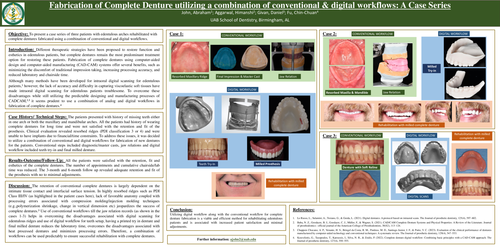
Case History/ Technical Steps: The patients presented with history of missing teeth either in one arch or both the maxillary and mandibular arches. All the patients had history of wearing complete dentures for long time and were not satisfied with the retention and fit of the prosthesis. Clinical evaluation revealed resorbed ridges (PDI classification 3 or 4) and were unable to have implants due to financial/time constraints. To address these issues, it was decided to utilize a combination of conventional and digital workflows for fabrication of new dentures for the patients. Conventional steps included diagnostic/master casts, jaw relations and digital workflow included teeth try-in and final milled denture.
Results-Outcome/Follow-Up: All the patients were satisfied with the retention, fit and esthetics of the complete dentures. The number of appointments and cumulative chairside/lab time was reduced. The 3-month and 6-month follow up revealed adequate retention and fit of the prosthesis with no to minimal adjustments.
Discussion: The retention of conventional complete dentures is largely dependent on the intimate tissue contact and interfacial surface tension. In highly resorbed ridges such as PDI Class III/IV (as highlighted in the patient cases here), lack of favorable anatomy coupled with processing errors associated with compression molding/injection molding techniques (e.g.,polymerization shrinkage, change in vertical dimension etc) jeopardizes the success of complete dentures.3 Use of conventional workflows till the jaw relation records (as shown in the cases 1-3) helps in overcoming the disadvantages associated with digital scanning for edentulous ridges and use of digital workflow for teeth setup, having a printed try in denture and final milled denture reduces the laboratory time, overcomes the disadvantages associated with heat processed dentures and minimizes processing errors. Therefore, a combination of workflows can be used predictably to ensure successful rehabilitation with complete dentures.
Conclusion:
Utilizing digital workflow along with the conventional workflow for complete denture fabrication is a viable and efficient method for rehabilitating edentulous patients and is associated with increased patient satisfaction and minimal adjustments.