127 posters, 2 topics, 24 sessions, 326 authors, 85 institutions
ePostersLive by SciGen Technologies S.A. All rights reserved.
2023 ACP ANNUAL SESSION
October 25-28 | San Diego, CA

145
Restoring Canine Guidance with All-Ceramic Palatal Veneers: A Case Report
Poster Presenter
Authors
Affiliations
DUMMY, United States Air Force Post-Graduate Prosthodontics program
Part of Topic
Case Presentation
Restoring Canine Guidance with All-Ceramic Palatal Veneers: A Case Report
Capt Airton D. Soares, DDS, Resident; Lt Col Wesley Shute, DDS, MS, FACP
INTRODUCTION
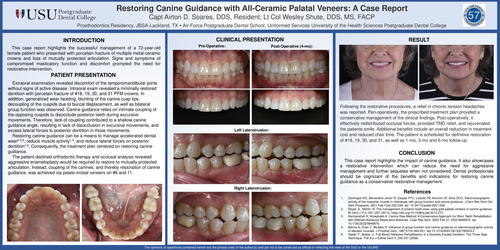
This case report highlights the successful management of a 72-year-old female patient who presented with porcelain fracture of multiple metal-ceramic crowns and loss of mutually protected articulation. Signs and symptoms of compromised masticatory function and discomfort prompted the need for restorative intervention.
PATIENT PRESENTATION
Extraoral examination revealed discomfort of the temporomandibular joints without signs of active disease. Intraoral exam revealed a minimally restored dentition with porcelain fracture of #18, 19, 30, and 31 PFM crowns. In addition, generalized wear faceting, blunting of the canine cusp tips, decoupling of the cuspids due to buccal displacement, as well as bilateral group function was observed. Canine guidance relies on intimate coupling of the opposing cuspids to disocclude posterior teeth during excursive movements. Therefore, lack of coupling contributed to a shallow canine guidance angle, resulting in lack of disocclusion in excursive movements, and excess lateral forces to posterior dentition in those movements.
Restoring canine guidance can be a means to manage accelerated dental wear2-3,5, reduce muscle activity1,4, and reduce lateral forces on posterior dentition1,4. Consequently, the treatment plan centered on restoring canine guidance.
The patient declined orthodontic therapy and occlusal analysis revealed aggressive enameloplasty would be required to restore to mutually protected articulation. Instead, coupling of the canines, and thereby restoration of canine guidance, was achieved via palato-incisal veneers on #6 and 11.
RESULT
Following the restorative procedures, a relief in chronic tension headaches was reported. Peri-operatively, the prescribed treatment plan provided a conservative management of the clinical findings. Post-operatively, it effectively redistributed occlusal forces, provided TMD relief, and rejuvenated the patients smile. Additional benefits include an overall reduction in treatment cost and reduced chair time. The patient is scheduled for definitive restoration of #18, 19, 30, and 31, as well as 1-mo, 3-mo and 6-mo follow-up.
CONCLUSION
This case report highlights the impact of canine guidance. It also showcases a restorative intervention which can reduce the need for aggressive management and further sequelae when not considered. Dental professionals should be cognizant of the benefits and indications for restoring canine guidance as a conservative restorative management.