127 posters, 2 topics, 24 sessions, 326 authors, 85 institutions
ePostersLive by SciGen Technologies S.A. All rights reserved.
2023 ACP ANNUAL SESSION
October 25-28 | San Diego, CA

131
Benefits and Challenges of Intraoral Positioning Stent for Head and Neck Cancer Radiation Therapy
Poster Presenter
Authors
Affiliations
Part of Topic
Case Presentation
Benefits and Challenges of Intraoral Positioning Stent for Head and Neck Cancer Radiation Therapy.
With the advent of modern radiotherapy (RT) techniques such as External Beam Radiation Therapy (EBRT) and Intensity Modulated Radiation Therapy (IMRT), it has allowed more effective treatment of patients with head and neck cancer. Nonetheless, numerous adverse effects of RT still persist among patients including xerostomia, oral mucositis, osteoradionecrosis, taste changes, trismus, and radiation-related caries. 1
Intraoral stent for radiotherapy (IS-RT) is an effective tool to aid the patient undergoing arduous RT due to its significant benefits. This customized device can reduce the variation and ensure precision in radiation dose between each fraction by providing a stable and reproducible patient position. 2 It also ensures more precise pre-irradiation planning and preserves surrounding healthy tissues from inadvertent irradiation. 3
Despite the evident benefits of IS-RT, there is a lack of consensus on its design and fabrication. In fact, various forms exist to serve multiple functions such as immobilization of the mandible and depression of the tongue.
A 26 y/o female patient diagnosed with nasopharyngeal carcinoma presented to the Postgraduate Prosthodontics clinic at Stony Brook University School of Dental Medicine with a referral from a radiation oncologist, for a pre-radiation dental consultation and to provide a mouth opening-tongue depressing intraoral stent to be used during Intensity-Modulated Radiation Therapy (IMRT). Initial appointment revealed clinical findings such as maximum mouth opening of 40mm, fully dentate maxilla, and mandible with no signs of caries or pathologies.
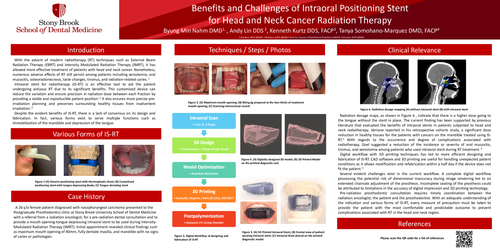
Radiation dosage maps, as shown in Figure 6, indicate that there is a higher dose going to the tongue without the stent in place. The current finding has been supported by previous literature that evaluated the benefits of intraoral stents in patients subjected to head and neck radiotherapy. Verrone reported in his retrospective cohorts study, a significant dose reduction in healthy tissues for the patients with cancers on the mandible treated using IS-RT.3 With regards to the occurrence and degree of complications associated with radiotherapy, Goel suggested a reduction of the incidence or severity of oral mucositis, trismus, and xerostomia among patients who used intraoral stent during RT treatment. 4
Digital workflow with 3D printing techniques has led to more efficient designing and fabrication of IS-RT. CAD software and 3D printing are useful for handling unexpected patient conditions as it allows modification and refabrication within a half day if the device does not fit the patient. 5
Several evident challenges exist in the current workflow. A complete digital workflow possessing the potential risk of dimensional inaccuracy during image rendering led to an extended chairside adjustment of the prosthesis. Incomplete seating of the prosthesis could be attributed to limitations in the accuracy of digital impression and 3D printing technology.
Pre-radiation prosthodontic consultation requires timely coordination between the radiation oncologist, the patient, and the prosthodontist. With an adequate understanding of the indication and various forms of IS-RT, every measure of precaution must be taken to provide the patient with the most comfortable and predictable outcome to prevent complications associated with RT in the head and neck region.