127 posters, 2 topics, 24 sessions, 326 authors, 85 institutions
ePostersLive by SciGen Technologies S.A. All rights reserved.
2023 ACP ANNUAL SESSION
October 25-28 | San Diego, CA

126
The role of the Cementoenamel junction during the diagnosis of a young patient with amelogenesis imperfecta and delayed passive eruption: a case report.
Poster Presenter
Authors
Affiliations
Part of Topic
Case Presentation
THE ROLE OF THE CEMENTO-ENAMEL JUNCTION DURING THE DIAGNOSIS OF A YOUNG PATIENT WITH
AMELOGENESIS IMPERFECTA AND DELAYED PASSIVE ERUPTION: A CASE REPORT.
Gabriel Feoli, DDS, Arturo Blanco, DMD, MSD, FACP
Prosthodontics Graduate Program, University of Puerto Rico, School of Dental Medicine, San Juan, PR
Introduction:
Minimal invasive adhesive dentistry is on the rise as a predictable long-term solution to many problems affecting the natural dentition teeth. Bonding to enamel and the cementoenamel junction (CEJ) location during the diagnostic phases are of utmost importance. However, locating the CEJ using the bone-sounding technique on patients with delayed eruption and congenital dental malformations like Amelogenesis imperfecta can be challenging. The Cone Beam Computed Technology (CBCT) can be a helpful tool for diagnosis and treatment planning with accuracy.
Purpose:
Demonstrate the use of digital technology to facilitate the detection of the CEJ position during the diagnosis and treatment planning of a young patient with amelogenesis imperfecta and delayed passive eruption.
Case Report:
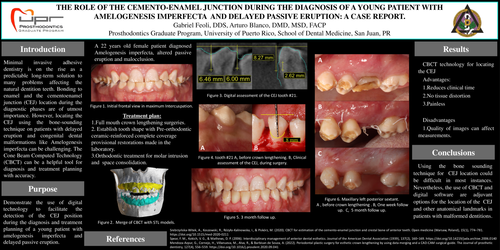
A 22 years old female patient diagnosed Amelogenesis imperfecta, altered passive eruption and malocclusion.
Treatment plan:
1.Full mouth crown lengthening surgeries.
2. Establish tooth shape with Pre-orthodontic ceramic-reinforced complete coverage provisional restorations made in the laboratory
3.Orthodontic treatment for molar intrusion and space consolidation
Results:
CBCT technology for locating the CEJ
Advantages:
1.Reduces clinical time
2.No tissue distortion
3.Painless
Disadvantages
1.Quality of images can affect measurements
Conclusions:
Using the bone sounding technique for CEJ location could be difficult in most instances. Nevertheless, the use of CBCT and digital software are adjuvant options for the location of the CEJ and other anatomical landmarks in patients with malformed dentitions.
References:
Srebrzyńska-Witek, A., Koszowski, R., Różyło-Kalinowska, I., & Piskórz, M. (2020). CBCT for estimation of the cemento-enamel junction and crestal bone of anterior teeth. Open medicine (Warsaw, Poland), 15(1), 774–781. https://doi.org/10.1515/med-2020-0211
Spear, F. M., Kokich, V. G., & Mathews, D. P. (2006). Interdisciplinary management of anterior dental esthetics. Journal of the American Dental Association (1939), 137(2), 160–169. https://doi.org/10.14219/jada.archive.2006.0140
Mendoza-Azpur, G., Cornejo, H., Villanueva, M., Alva, R., & Barbisan de Souza, A. (2022). Periodontal plastic surgery for esthetic crown lengthening by using data merging and a CAD-CAM surgical guide. The Journal of prosthetic dentistry, 127(4), 556–559. https://doi.org/10.1016/j.prosdent.2020.09.041