127 posters, 2 topics, 24 sessions, 326 authors, 85 institutions
ePostersLive by SciGen Technologies S.A. All rights reserved.
2023 ACP ANNUAL SESSION
October 25-28 | San Diego, CA

118
“ A Novel Approach to Reduce Microbial Adhesion, Cost and Weight of ill-Fitting Obturators Using a Digital Workflow”
Poster Presenter
Authors
Affiliations
Part of Topic
Case Presentation
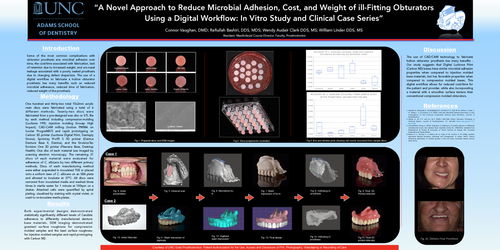
“A Novel Approach to Reduce Microbial Adhesion, Cost, and Weight of ill-Fitting Obturators Using a Digital Workflow: In Vitro Study and Clinical Case Series”
Some of the most common complications with obturator prosthesis are: microbial adhesion over time, the cost/time associated with fabrication, lack of retention due to increased weight, and oro-nasal leakage associated with a poorly sealed prosthesis due to changing defect shape/size. The use of a digital workflow to fabricate a hollow obturator prosthesis has many benefits such as reduced microbial adherence, reduced time of fabrication, reduced weight of the prosthesis.
The use of CAD/CAM technology to fabricate hollow obturator prosthesis has many benefits . Our study suggests that Digital Lucitone Print (Carbon M2) bases have similar microbial adhesion properties when compared to injection molded base materials, but has favorable properties when compared to compression molded bases. This digital workflow allows for reduced cost/time for the patient and provider, while also incorporating a material with a smoother surface texture than conventional compression molded obturators.