105 posters, 2 topics, 24 sessions, 264 authors, 71 institutions
ePostersLive by SciGen Technologies S.A. All rights reserved.
2022 ACP Annual Session
2 - 5 November | Austin, TX

89
Stereophotogrammetry in the Digital Workflow for the Fabrication of Implant-supported Fixed Complete Prostheses
Poster Presenter
Authors
Dalia Waia, Rand Harlow , David Shonberg, Sandra Altarawneh, Leila Ahmadian, Bin Yang
Affiliations
Part of Topic
Case Presentation
Title: Stereophotogrammetry in the Digital Workflow for the Fabrication of Implant-Supported Fixed Complete Prostheses
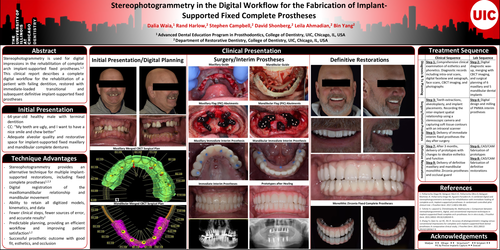
Abstract: Stereophotogrammetry is used for digital impressions in the rehabilitation of complete arch implant-supported fixed prostheses.1,2 This clinical report describes a complete digital workflow for the rehabilitation of a patient with failing dentition, restored with immediate-loaded transitional and subsequent definitive implant-supported fixed prostheses
Initial Presentation:
-
64-year-old healthy male with terminal dentition
-
CC: “My teeth are ugly, and I want to have a nice smile and chew better”
-
Adequate alveolar quality and restorative space for implant-supported fixed maxillary and mandibular complete dentures
Technique Advantages:
Step 1: Comprehensive clinical examination of esthetics and phonetics. Diagnostic records including intra-oral scans, digital facebow and axiograph, face scans, CBCT imaging, and photographs
Step 2: Digital diagnostic wax-up, merging with CBCT imaging, and surgical planning of 6 maxillary and 5 mandibular dental implants
Step 3: Teeth extractions, alveoloplasty, and implant placements. Recording the inter-implant spatial relationship using a stereoscopic camera and capturing soft tissue contours with an intraoral scanner
Step 4: Digital design and milling of PMMA interim prostheses
Step 5: Delivery of immediate interim fixed prostheses the day after surgery
Step 6: CAD/CAM fabrication of prototypes
Step 7: After 3 months, delivery of prototypes with changes to idealize esthetics and function
Step 8: CAD/CAM fabrication of definitive restorations
Step 9: Delivery of definitive maxillary and mandibular monolithic Zirconia prostheses and occlusal guard
References:
1- Peñarrocha-Diago M, Balaguer-Martí JC, Peñarrocha-Oltra D, Balaguer-Martínez JF, Peñarrocha-Diago M, Agustín-Panadero R. A combined digital and stereophotogrammetric technique for rehabilitation with immediate loading of complete-arch, implant-supported prostheses: A randomized controlled pilot clinical trial. J Prosthet Dent. 2017;118(5):596-603.
2- Tohme H, Lawand G, Chmielewska M, Makhzoume J. Comparison between stereophotogrammetric, digital, and conventional impression techniques in implant-supported fixed complete arch prostheses: An in vitro study. J Prosthet Dent. 2021;S0022-3913(21)00269-9.
3- Zhang YJ, Qian SJ, Lai HC, Shi JY. Accuracy of photogrammetric imaging versus conventional impressions for complete-arch implant-supported fixed dental prostheses: A comparative clinical study. J Prosthet Dent. 2021;S0022-3913(21)00567-9.
Acknowledgements: Modjaw ⬥⬥ 3Shape ⬥⬥ Straumann® ⬥⬥ Simplant ⬥⬥ PIC by Precise Implants Capture ⬥⬥ Exocad