105 posters, 2 topics, 24 sessions, 264 authors, 71 institutions
ePostersLive by SciGen Technologies S.A. All rights reserved.
2022 ACP Annual Session
2 - 5 November | Austin, TX

107
Segmented Cast Diagnosis: Application and Implementation
Poster Presenter
Authors
Mayur Nayee, Maria Mora, Keith Kinderknecht , Wen-chou Wu, Nada Souccar
Affiliations
Part of Topic
Case Presentation
Purpose
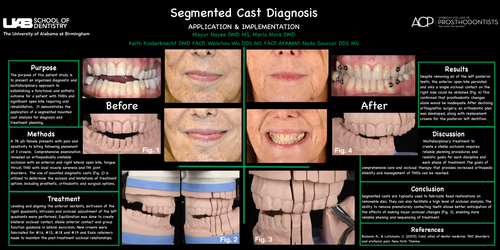
The purpose of this patient study is to present an organized diagnostic and multidisciplinary approach to establishing a functional and esthetic outcome for a patient with TMDs and significant open bite requiring oral rehabilitation. It demonstrates the application of a segmented mounted cast analysis for diagnosis and treatment planning.
Methods
A 78 y/o female presents with pain and sensitivity to biting following placement of 3 crowns. Comprehensive examination revealed an orthopedically unstable occlusion with an anterior and right lateral open bite, tongue thrust, TMD with local muscle soreness and TM joint disorders. The use of mounted diagnostic casts (Fig. 2) is utilized to determine the success and limitations of treatment options including prosthetic, orthodontic and surgical options.
Treatment
Leveling and aligning the anterior sextants, extrusion of the right quadrants, intrusion and occlusal adjustment of the left quadrants were performed. Equilibration was done to create bilateral occlusal contact, stable anterior contact and group function guidance in lateral excursion. New crowns were fabricated for #14, #15, #18 and #19 and Essix retainers made to maintain the post-treatment occlusal relationships.
Results
Despite removing all of the left posterior teeth, the anterior open bite persisted and only a single occlusal contact on the right side could be obtained (Fig. 4) This confirmed that prosthodontic changes alone would be inadequate. After declining orthognathic surgery, an orthodontic plan was developed, along with replacement crowns for the posterior left dentition.
Discussion
Multidisciplinary treatment to create a stable occlusion requires reliable planning procedures and realistic goals for each discipline and each phase of treatment. The goals of comprehensive care and occlusal therapy that provides increased orthopedic stability and management of TMDs can be reached.
Conclusion
Segmented casts are typically used to fabricate fixed restorations on removable dies. They can also facilitate a high level of occlusal analysis. The ability to remove prematurely contacting teeth allows better anticipation of the effects of making major occlusal changes (Fig. 3), enabling more reliable phasing and sequencing of treatment.
References
Bumann, A., & Lotzmann, U. (2003). Color atlas of dental medicine. TMJ disorders and orofacial pain. New York: Theime.