105 posters, 2 topics, 24 sessions, 264 authors, 71 institutions
ePostersLive by SciGen Technologies S.A. All rights reserved.
2022 ACP Annual Session
2 - 5 November | Austin, TX

102
The Dahl to the rescue!
Poster Presenter
Authors
Affiliations
Part of Topic
Case Presentation
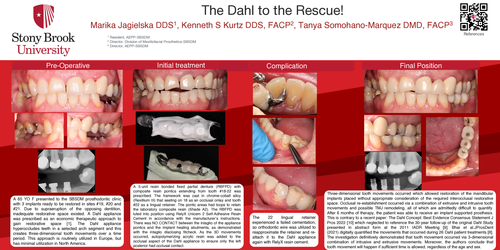
A 65 YO F presented to the SBSDM prosthodontic clinic with 3 implants ready to be restored in sites #19, #20 and #21. Due to supraeruption of the opposing dentition, inadequate restorative space existed. A Dahl appliance was prescribed as an economic therapeutic approach to gain restorative space [1]. The Dahl appliance hyperoccludes teeth in a selected arch segment and this creates three-dimensional tooth movements over a time period. This approach is routinely utilized in Europe, but has minimal utilization in North America.
A 5-unit resin bonded fixed partial denture (RBFPD) with composite resin pontics extending from tooth #18-22 was prescribed. The framework was cast in chrome-cobalt alloy (Rexillium III) that seating on 18 as an occlusal onlay and tooth #22 as a lingual retainer. The pontic areas had loops to retain the laboratory composite resin (Shade A2). The RBFPD was luted into position using RelyX Unicem 2 Self-Adhesive Resin Cement in accordance with the manufacturer’s instructions. There was NO CONTACT between the intaglio of the appliance pontics and the implant healing abutments, as demonstrated with the intaglio disclosing fitcheck. As the 3D movements occurred, autopolymerizing acrylic resin was added to the occlusal aspect of the Dahl appliance to ensure only the left posterior had occlusal contact.
The 22 lingual retainer experienced a failed cementation, so orthodontic wire was utilized to reapproximate the retainer and re-attach it to the Dahl appliance again with RelyX resin cement.
Three-dimensional tooth movements occurred which allowed restoration of the mandibular implants placed without appropriate consideration of the required interocclusal restorative space. Occlusal re-establishment occurred via a combination of extrusive and intrusive tooth movements and possible TMJ remodeling, all of which are admittedly difficult to quantify. After 6 months of therapy, the patient was able to receive an implant supported prosthesis. This is contrary to a recent paper: The Dahl Concept: Best Evidence Consensus Statement J Pros 2022 [10] which neglected to reference the 30-year follow-up of the original Dahl Study presented in abstract form at the 2011 IADR Meeting [9]. Bhai et al.JProsDent (2021) digitally quantified the movements that occurred during 26 Dahl patient treatments [8]. The investigation definitively demonstrated that tooth movement occurred via 3-dimensional combination of intrusive and extrusive movements. Moreover, the authors conclude that tooth movement will happen if sufficient time is allowed, regardless of the age and sex.