105 posters, 2 topics, 24 sessions, 264 authors, 71 institutions
ePostersLive by SciGen Technologies S.A. All rights reserved.
2022 ACP Annual Session
2 - 5 November | Austin, TX

83
Temporomandibular Joint Replacement as treatment for post-traumatic condylar fractures <p>A Case Report and 3 year Follow-up</p>
Poster Presenter
Authors
Lamprini Leotsakou, Isaias Abrego, Michael Shannon , Gary Klasser , Amir Nejat
Affiliations
Part of Topic
Case Presentation
Temporomandibular joint (TMJ) ankylosis is an extremely disabling affliction that causes problems in mastication, speech, appearance, and hygiene. Trauma is thought to account for approximately 0.4% of ankylosis cases related to the TMJ complex. Early diagnosis and intervention of cases with condylar fracture can be crucial to minimize the potential effects of late complications including ankyloses such as limitation in the opening.
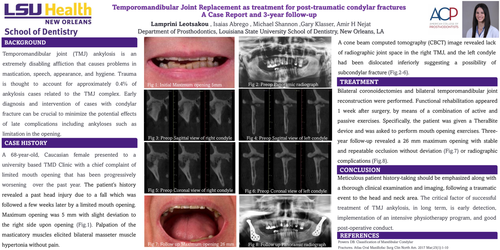
A 68-year-old, Caucasian female presented to a university-based TMD Clinic with a chief complaint of limited mouth opening that has been progressively worsening over the past year. The patient’s history revealed a past head injury due to a fall which was followed a few weeks later by a limited mouth opening. The maximum opening was 5 mm with a slight deviation to the right side upon opening (Fig.1). Palpation of the masticatory muscles elicited bilateral masseter muscle hypertonia without pain.
A cone beam computed tomography (CBCT) image revealed lack of radiographic joint space in the right TMJ, and the left condyle had been dislocated inferiorly suggesting a possibility of subcondylar fracture (Fig.2-6).
Bilateral coronoidectomies and bilateral temporomandibular joint reconstruction were performed. Functional rehabilitation appeared 1 week after surgery, by means of a combination of active and passive exercises. Specifically, the patient was given a TheraBite device and was asked to perform mouth opening exercises. Three-year follow-up revealed a 26 mm maximum opening with stable and repeatable occlusion without deviation (Fig.7) or radiographic complications (Fig.8).
Meticulous patient history-taking should be emphasized along with a thorough clinical examination and imaging, following a traumatic event to the head and neck area. The critical factor of successful treatment of TMJ ankylosis, in long term, is early detection, implementation of an intensive physiotherapy program, and good post-operative conduct.