105 posters, 2 topics, 24 sessions, 264 authors, 71 institutions
ePostersLive by SciGen Technologies S.A. All rights reserved.
2022 ACP Annual Session
2 - 5 November | Austin, TX

80
Mandibular Implant-retained rehabilitation of a patient with ameloblastoma
Poster Presenter
Authors
Affiliations
Part of Topic
Case Presentation
Mandibular Implant-retained rehabilitation of a patient with ameloblastoma.
Ameloblastoma is a benign, slow-growing, locally invasive odontogenic tumor and
accounts for 11% of all odontogenic tumors.1 It affects mainly adult patients between the
third to the seventh decade of their life but is most commonly diagnosed in the third and
fourth decades.2,3 Patients frequently represent asymptomatic bulging or a large lesion,
perforating the cortical bone, shifting tissue, and causing tooth resorption.4 It affects the
mandible four times more than the maxilla; it is more frequent in the molar region and the
mandibular ramus4; however, it can also be found in the maxillary sinus and nasal cavity.
Treatment may vary from curettage to broad bone resections, with or without
reconstruction. Radiotherapy is not indicated because the lesion is radioresistant. In the
literature, we also find indications for electrocauterization, cryosurgery, and the use of
sclerosant agents as treatment options.1 Image exams are essential in the post-op followup
because over 50% of the recurrences happen in the first five years of postoperative.
1,5
We present an adult patient with a rare anterior mandibular ameloblastoma who needed a
resection of the anterior mandible and full arch extraction, followed by comprehensive
prosthodontic rehabilitation.
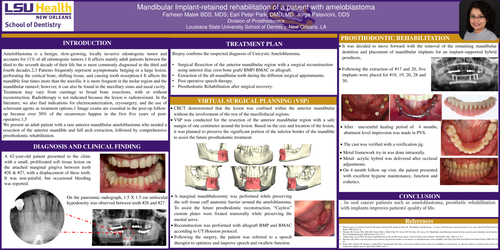
A 42-year-old patient presented to the clinic
with a small, proliferated soft tissue lesion on
the attached marginal gingiva between teeth
#26 & #27, with a displacement of these teeth.
It was non-painful, but occasional bleeding
was reported.
On the panoramic radiograph, 1.5 X 1.5 cm unilocular
hypodensity was observed between teeth #26 and #27.