105 posters, 2 topics, 24 sessions, 264 authors, 71 institutions
ePostersLive by SciGen Technologies S.A. All rights reserved.
2022 ACP Annual Session
2 - 5 November | Austin, TX
72
Treatment of Adult Ectodermal Dysplasia Utilizing a Hybrid Digital Workflow
Poster Presenter
Authors
Affiliations
Part of Topic
Case Presentation
INTRODUCTION
Ectodermal dysplasia presents many restorative challenges, especially in patients without a stable occlusion and collapsed occlusal vertical dimension. Utilizing a digital workflow in conjunction with analog techniques allowed for frictionless transfer of digital design to prosthesis fabrication.
Ectodermal dysplasia is a collection of rare, heritable conditions marked by disruption in structures of ectodermal origin, including sebaceous glands, teeth, and hair. Oligodontia and retained primary teeth are common in these patients, leading to improper occlusion with impaired masticatory ability and need for cosmesis.
CASE PRESENTATION
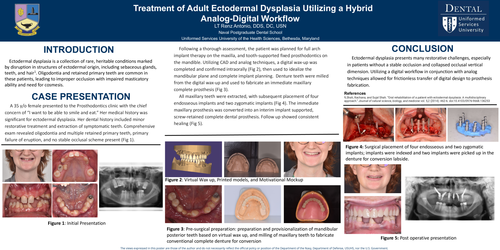
A 35 y/o female presented to the Prosthodontics clinic with the chief concern of “I want to be able to smile and eat.” Her medical history was significant for ectodermal dysplasia. Her dental history included minor restorative treatment and extraction of symptomatic teeth. Comprehensive exam revealed oligodontia and multiple retained primary teeth, primary failure of eruption, and no stable occlusal scheme present (Fig 1).
Following a thorough assessment, the patient was planned for full arch implant therapy on the maxilla, and tooth-supported fixed prosthodontics on the mandible. Utilizing CAD and analog techniques, a digital wax-up was completed and confirmed intraorally (Fig 2), then used to idealize the mandibular plane and complete implant planning. Denture teeth were milled from the digital wax-up and used to fabricate an immediate maxillary complete prosthesis (Fig 3).
All maxillary teeth were extracted, with subsequent placement of four endosseous implants and two zygomatic implants (Fig 4). The immediate maxillary prosthesis was converted into an interim implant supported, screw-retained complete dental prosthesis. Follow up showed consistent healing (Fig 5).
CONCLUSION
Ectodermal dysplasia presents many restorative challenges, especially in patients without a stable occlusion and collapsed occlusal vertical dimension. Utilizing a digital workflow in conjunction with analog techniques allowed for frictionless transfer of digital design to prosthesis fabrication.
Figure 1: Initial Presentation
Figure 2: Virtual Wax up, Printed models, and Motivational Mockup
Figure 3: Pre-surgical preparation: preparation and provisionalization of mandibular posterior teeth based on virtual wax up, and milling of maxillary teeth to fabricate conventional complete denture for conversion
Figure 4: Surgical placement of four endosseous and two zygomatic implants; implants were indexed and two implants were picked up in the denture for conversion labside.Figure 5: Post operative presentation
References
1.Shah, Rachana, and Sujal Shah. “Oral rehabilitation of a patient with ectodermal dysplasia: A multidisciplinary approach.” Journal of natural science, biology, and medicine vol. 5,2 (2014): 462-6. doi:10.4103/0976-9668.136253