105 posters, 2 topics, 24 sessions, 264 authors, 71 institutions
ePostersLive by SciGen Technologies S.A. All rights reserved.
2022 ACP Annual Session
2 - 5 November | Austin, TX

68
“Complete Digital Workflow in Fabricating Maxillary Tooth-borne Overdenture: A Case Report for a Patient with History of Rhabdomyosarcoma”
Poster Presenter
Authors
Riley Allen, Rafiullah Bashiri, Renata Camino, David Felton, Junior Jaramillo
Affiliations
Part of Topic
Case Presentation
“Complete Digital Workflow in Fabricating Maxillary Tooth-borne Overdenture: A Case Report for a Patient with History of Rhabdomyosarcoma”
Objectives:
To restore a complex partially edentulous patient with history of multiple prior treatments for Rhabdomyosarcoma. A novel complete digital workflow was utilized as the treatment of choice.
Methods:
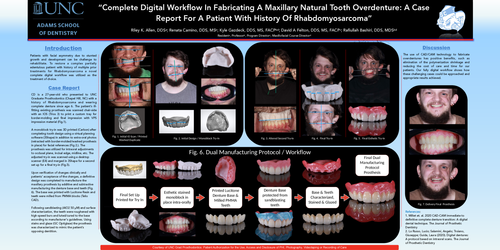
The patient’s ill-fitting existing prosthesis was scanned chairside with an IOS (Trios 3) to print a custom tray for border-molding and final impression with VPS impression material.
A monoblock try-in was 3D printed (Carbon) after completing tooth design using a virtual planning software (3Shape) in addition to extra-oral photos (retracted with border-molded/washed prosthesis in place) for facial references. The prosthesis was utilized for intraoral adjustments to occlusal plane, incisal edge, midline, etc. The adjusted try-in was scanned using a desktop scanner (E4) and merged in 3Shape for a second set up for a final try-in.
Upon verification of changes clinically and patients' acceptance of the changes, a definitive design was completed to manufacture the maxillary prosthesis by additive and subtractive manufacturing the denture base and teeth. The base was printed with Lucitone Resin and teeth were milled from PMMA blocks (Telio CAD).
Following sandblasting (AlO2 50 μM) and surface characterization, the teeth were roughened with high-speed burs and luted/cured to the base according to manufacturer's guidelines. Using stains and glaze (GC Optiglaze) the prosthesis was characterized to mimic the patient’s opposing dentition.
Results:
The patient was happy with the highly esthetic rehabilitation completed through this unique fully digital workflow for a tooth-borne overdenture. The manufacturing and finishing method used improved the clinical outcome of our removable overdenture prosthesis.
Conclusions:
The use of CAD/CAM technology to fabricate overdentures has positive benefits, such as elimination of the polymerization shrinkage and reducing the cost of care and time for our patients. The use of such technologies in fabricating prostheses for patients with complex deformities has always been a challenge. As Prosthodontics transitions to the world of CAD/CAM, competency in making acceptable digital impressions, determining the appropriate OVD and capturing accurate records, applying esthetic principles and intervention for behavioral modification when required will continue to play a predominant role. Our fully digital workflow shows how these challenging cases could be approached and appropriate results achieved.