105 posters, 2 topics, 24 sessions, 264 authors, 71 institutions
ePostersLive by SciGen Technologies S.A. All rights reserved.
2022 ACP Annual Session
2 - 5 November | Austin, TX

67
Weighted mandibular complete denture: Incorporation of digital workflow in a classic technique.
Poster Presenter
Authors
Affiliations
Part of Topic
Case Presentation
Weighted mandibular complete denture: Incorporation of digital workflow in a classic technique.
Objective
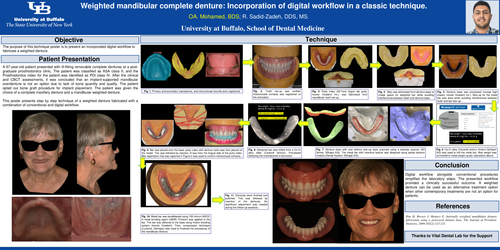
The purpose of this technique poster is to present an incorporated digital workflow to fabricate a weighted denture.
Patient Presentation
A 67-year-old patient presented with ill-fitting removable complete dentures at a post-graduate prosthodontics clinic. The patient was classified as ASA class II, and the Prosthodontics index for the patient was identified as PDI class IV. After the clinical and CBCT assessments, it was concluded that an implant-supported mandibular overdenture is not an option due to lack of bone quantity and quality. The patient opted out bone graft procedure for implant placement. The patient was given the choice of a complete maxillary denture and a mandibular weighted denture.
This poster presents step by step technique of a weighted denture fabricated with a combination of conventional and digital workflow.
Fig. 1: Primary and secondary impressions, and interocclusal records were registered
Fig. 2: Tooth set-up was verified. Interocclusal contacts was registered on the articulator.
Fig. 3: Putty index (Sil-Tech Super lab putty; Ivoclar Vivadent Inc.) was fabricated from mandibular tooth set-up.
Fig. 4: Wax was eliminated from denture base to create space for weighted bar while avoiding interferences between teeth and denture base.
Fig. 5: Denture base was processed (Ivocap high impact, Ivoclar Vivadent Inc.). Wax-up for the metal bar was done while avoiding interferences between teeth and bar wax-up.
Fig. 6: Co-Cr alloy (Ceramill sintron; Amann Girrbach AG) was used to mill the metal bar. Wax weight was converted to metal weight as per calculation above.
Fig. 7: Denture base with and without wax-up were scanned using a desktop scanner (E4 Series; 3Shape A/S). The metal bar with retentive feature was designed using partial denture module (Dental System; 3Shape A/S).
Fig. 8: Designed bar was milled from a Co-Cr alloy billet (Ceramill Sintron). Processed following the manufacturer’s instruction
Fig. 9: Bar was placed onto the base, putty index with denture teeth was then placed on the model. This was followed by injection of wax from the lingual side of the putty index. Bite registration that was captured in Figure 2 was used to confirm interocclusal contacts.
Fig. 10: Metal bar was sandblasted using 100-micron Al2O3. A metal bonding agent (UBAR, Protech) was applied to the bar. The bar was adhered to the base using Ivotion bonding system (Ivoclar Vivadent). Then, compression technique (Lucitone, Dentsply) was used to finalized the processing of the mandibular denture.
Fig. 11: Dentures were finished and polished. This was followed by insertion of the dentures. No significant adjustment was needed during the follow-up sessions.
Conclusion
Digital workflow alongside conventional procedures simplifies the laboratory steps. The presented workflow provided a clinically successful outcome. A weighted denture can be used as an alternative treatment option when other contemporary treatments are not an option for patients.
References
Kim H, Brewer J, Monaco E. Internally weighted mandibular denture fabrication using a processed denture base. The Journal of Prosthetic Dentistry. 2009;102(2):123-125.