105 posters, 2 topics, 24 sessions, 264 authors, 71 institutions
ePostersLive by SciGen Technologies S.A. All rights reserved.
2022 ACP Annual Session
2 - 5 November | Austin, TX

58
Title: <em>Full Mouth Fixed Prosthodontic Rehabilitation using Digital Dentistry Protocols in Patient with Amelogenesis Imperfecta: A Clinical Report.</em>
Poster Presenter
Authors
Affiliations
Part of Topic
Case Presentation
Full Mouth Fixed Prosthodontic Rehabilitation using Digital Dentistry Protocols in Patient with Amelogenesis Imperfecta: A Clinical Report.
Bhavinkumar Patel B.D.S, Berna Saglik D.D.S. M.S, University of Michigan School of Dentistry.
INTRODUCTION
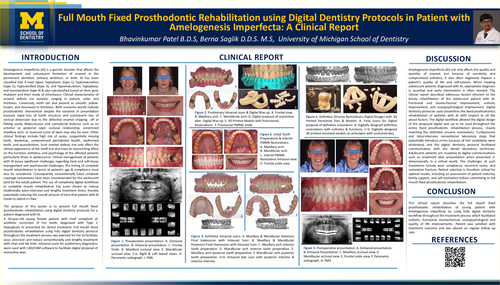
Amelogenesis imperfecta (AI) is a genetic disorder that affects the development and subsequent formation of enamel in the permanent dentition, primary dentition, or both. AI has been classified into 4 main types: hypoplastic (type 1), hypomaturation (type 2), hypocalcified (type 3), and hypomaturation, hypoplasia, and taurodontism (type 4) & also subclassified based on their gene mutation and their mode of inheritance. Clinical characteristics of enamel defects are variable, ranging in texture, color, and thickness. Conversely, teeth can also present as smooth, yellow- brown, and decreased in thickness. Both scenarios would indicate prosthodontic intervention despite the variation in presentation because rapid loss of tooth structure and subsequent loss of vertical dimension due to the defective enamel chipping off or flaking easily. Malocclusion and craniofacial features such as an anterior or posterior open occlusal relationship, constricted maxillary arch, or reversed curve of Spee may also be seen. Other clinical findings include high risk of caries, congenitally missing teeth, diastemas, compromised periodontal health, malformed teeth, and taurodontism. Such enamel defects not only affect the clinical appearance of the teeth but also have an overarching effect on the function, esthetics, and psychology of the affected patients particularly those in adolescence. Clinical management of patients with AI poses significant challenges regarding hard and soft-tissue management and psychosocial challenges, the timing of complete mouth rehabilitation in terms of patient’s age & compliance must also be considered. Consequently, conventionally luted complete coverage restorations have been recommended for the adolescent (and for the adult) patient. The use of completely digital workflows in complete mouth rehabilitation has been shown to reduce traditionally labor-intensive and lengthy treatment times, thereby potentially reducing the overall amount of time that patient with AI needs to spend in chair.
The purpose of this poster is to present full mouth fixed prosthodontic rehabilitation using digital dentistry protocols for a patient diagnosed with AI.
A 20-year-old young female patient with chief complaint of aesthetic correction of her teeth, diagnosed with Type 1 Hypoplastic AI presented for dental treatment. Full mouth fixed prosthodontic rehabilitation using fully digital dentistry protocol throughout the treatment process was planned for her to facilitate ease, precision and reduce conventionally and lengthy treatment with chair and lab time. Intraoral scans for preliminary diagnostics were used with CAD/CAM software to facilitate digital proposal of restorative plan.
DISCUSSION
Amelogenesis imperfecta (AI) not only affects the quality and quantity of enamel, but because of sensitivity and compromised esthetics, it also often negatively impacts a patient’s quality of life and self-esteem. When treating adolescent patients diagnosed with AI, appropriate diagnosis is essential and early intervention is often needed. The clinical report described addresses factors inherent to the timely rehabilitation of the adolescent patient with AI: functional and biomechanical improvement, esthetic improvement, and sociopsychological improvement. Digital dentistry protocols used streamlines the fixed prosthodontics rehabilitation of patients with AI with respect to all the above factors. The digital workflow allowed the digital design of the proposed digital wax up to be used throughout the entire fixed prosthodontic rehabilitation process, closely matching the definitive zirconia restorations. Cumbersome and labor-intensive conventional laboratory steps that potentially introduce errors because of heir complexity were eliminated, and the digital dentistry protocol facilitated communication with the dental laboratory technician. Adolescent patients are receptive to digital communications such as treatment plan presentation when presented 3- dimensionally in a virtual world. The challenges of such treatments include poor compliance, recurrent caries, and restoration fracture. Patient selection is therefore critical for optimal results, including an assessment of patient maturity, family support, and self-motivation before committing to full mouth fixed prosthodontic rehabilitation.
CONCLUSION
This clinical report describes the full mouth fixed prosthodontic rehabilitation of young patient with Amelogenesis Imperfecta by using fully digital dentistry workflow throughout the treatment process which facilitated esthetic, functional, biomechanical, sociopsychological and quality of life improvements. .Patient was satisfied with treatment outcome and was placed on regular follow up care.