105 posters, 2 topics, 24 sessions, 264 authors, 71 institutions
ePostersLive by SciGen Technologies S.A. All rights reserved.
2022 ACP Annual Session
2 - 5 November | Austin, TX

50
Completely Digital Workflow for fabrication of Occlusal Appliances. Case Presentation
Poster Presenter
Authors
Affiliations
Part of Topic
Case Presentation
INTRODUCTION
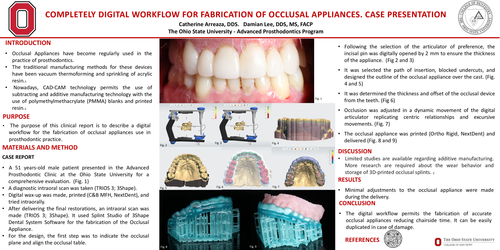
• The purpose of this clinical report is to describe a digital workflow for the fabrication of occlusal appliances use in prosthodontic practice.
MATERIALS AND METHOD
CASE REPORT
• A 51 years-old male patient presented in the Advanced Prosthodontic Clinic at the Ohio State University for a comprehensive evaluation. (Fig. 1)
•A diagnostic intraoral scan was taken (TRIOS 3; 3Shape).
DISCUSSION
RESULTS
•Minimal adjustments to the occlusal appliance were made during the delivery.
CONCLUSION
•The digital workflow permits the fabrication of accurate occlusal appliances reducing chairside time. It can be easily duplicated in case of damage.
REFERENCES
- Lutz, A. M., Hampe, R., Roos, M., Lümkemann, N., Eichberger, M., & Stawarczyk, B. (2019). Fracture resistance and 2-body wear of 3-dimensional–printed occlusal devices. Journal of Prosthetic Dentistry, 121(1), 166–172. https://doi.org/10.1016/j.prosdent.2018.04.007
- Grymak, A., Aarts, J. M., Ma, S., Waddell, J. N., & Choi, J. J. E. (2021). Wear Behavior of Occlusal Splint Materials Manufactured By Various Methods: A Systematic Review. Journal of Prosthodontics, 0, 1–15. https://doi.org/10.1111/jopr.13432
- Benli, M., Eker Gümüş, B., Kahraman, Y., Gökçen-Rohlig, B., Evlioğlu, G., Huck, O., & Özcan, M. (2020). Surface roughness and wear behavior of occlusal splint materials made of contemporary and high-performance polymers. Odontology, 108(2), 240–250. https://doi.org/10.1007/s10266-019-00463-1
- Perea-Lowery, L., Gibreel, M., Vallittu, P. K., & Lassila, L. (2021). Evaluation of the mechanical properties and degree of conversion of 3D printed splint material. Journal of the Mechanical Behavior of Biomedical Materials, 115(November 2020), 104254. https://doi.org/10.1016/j.jmbbm.2020.104254