105 posters, 2 topics, 24 sessions, 264 authors, 71 institutions
ePostersLive by SciGen Technologies S.A. All rights reserved.
2022 ACP Annual Session
2 - 5 November | Austin, TX

43
Prosthodontics Rehabilitation for a Patient with Treacher Collins and Pierre Robin Syndromes using 3D printed obturator and complete denture: A Clinical Report.
Poster Presenter
Authors
Safa Alrashed, Hesham Alouthah, Wei-Shao Lin, John Levon, Ben Anderson
Affiliations
DUMMY, Indiana University Purdue University Indianapolis, DUMMY, DUMMY
Part of Topic
Case Presentation
Prosthodontics Rehabilitation for a Patient with Treacher Collins and Pierre Robin Syndromes using 3D printed obturator and complete denture: A Clinical Report.
INTRODUCTION
Treacher Collins syndrome (TCS) is a rare genetic disorder that affects craniofacial development. TCS is characterized by bilateral deformities of the orbital area, ears, and jaws. Convex facial profile, skeletal class II, hypoplastic maxillary and zygomatic bones, cleft palate, speech problem, anterior open bite, micrognathia, retrognathia of the mandible. However, Pierre Robin syndrome (PRS) is a sequence of malformations that typically begins with micrognathia and progresses to glossoptosis and upper airway obstruction. It is commonly associated with a wide U-shaped palatal cleft.
PATIENT PRESENTATION
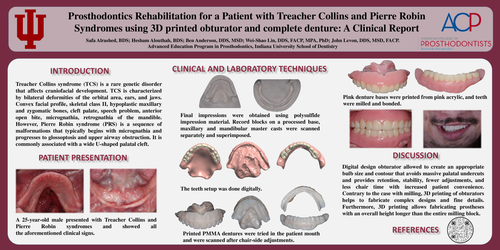
A 25-year-old male presented with Treacher Collins and Pierre Robin syndromes and showed all the aforementioned clinical signs.
CLINICAL AND LABORATORY TECHNIQUES
Final impressions were obtained using polysulfide impression material. Record blocks on a processed base, maxillary and mandibular master casts were scanned separately and superimposed.
The teeth setup was done digitally.
Printed PMMA dentures were tried in the patient mouth and were scanned after chair-side adjustments.
Pink denture bases were printed from pink acrylic, and teeth were milled and bonded.
DISCUSSION
Digital design obturator allowed to create an appropriate bulb size and contour that avoids massive palatal undercuts and provides retention, stability, fewer adjustments, and less chair time with increased patient convenience. Contrary to the case with milling, 3D printing of obturators helps to fabricate complex designs and fine details. Furthermore, 3D printing allows fabricating prostheses with an overall height longer than the entire milling block.