105 posters, 2 topics, 24 sessions, 264 authors, 71 institutions
ePostersLive by SciGen Technologies S.A. All rights reserved.
2022 ACP Annual Session
2 - 5 November | Austin, TX

38
Amelogenesis imperfecta and anterior open bite: case report and review of the literature.
Poster Presenter
Part of Topic
Case Presentation
Amelogenesis imperfecta and anterior open bite: case report and review of the literature.
Christiana Onisiforou, DMD, Andreas Onisiforou, DMD, Berna Saglik, DDS, MS, Charles Beard, DDS, MS.
University of Michigan, School of Dentistry
Introduction
Although amelogenesis imperfecta is a rare anomaly with an estimated prevalence of 1:2,000 (Witkop and Sauk, 1976), it has been detailed and reported in the literature time and time again. Of special clinical consideration is the frequent association of anterior open bite (AOB) in patients with amelogenesis imperfecta (AI). The incidence of AOB in patients with AI varies from 24%-60% (Witkop and Sauk, 1976; Rowley et al., 1982).
Opinions on the etiology for this co-existence is believed to be either skeletal, genetic, or local. The skeletal type arises from a vertical dysgnathia possibly related to abnormal skull development (Schulze, 1970). It may also be attributed to the pleiotropic action of the AI genes, influencing the growth of the craniofacial skeleton (Isell, 1956). A tongue-thrusting habit may act as a local impediment to alveolar growth and lead to anterior open-bite (Witkop, 1967).
Various etiologies have been matched with several treatment strategies, depending on the age of the patient, the skeletal developmental status, the quality and quantity of enamel and the periodontal condition (Alachioti, 2014). Treatment of such patients is a challenge for any clinician and typically requires multidisciplinary approach. The purpose of this case report is to demonstrate the non-surgical treatment of a patient with AI and AOB using occlusal equilibration.
Case report
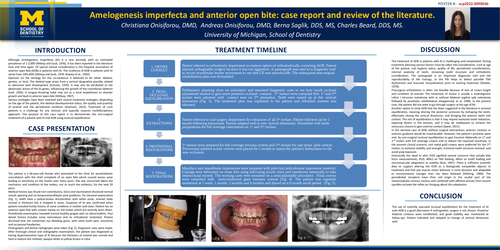
The patient is a 66-year-old female who presented to the clinic for prosthodontic consultation with the chief complaint of an open bite which caused excess wear leading to sensitivity on the molars over many years. She was concerned about the mechanics and condition of the molars, not so much the esthetics, for the next 20 years.
Medical history was found non-contributory. Extra-oral examination disclosed normal mouth opening and no temporomandibular joint problems. On intraoral examination, teeth have a yellow-brown discoloration with white areas, enamel looks normal in thickness but is chipped in areas. Suspicion of AI was confirmed when patient revealed family history of same condition in mother and sister. Patient has an anterior open bite with contact mainly on 3rd molars which are severely worn down. The periodontal examination revealed normal healthy gingiva with no abnormalities. Her past dental history includes some restorations and no orthodontic treatment. Patient disclosed that she sometimes has bleeding gums, with some tooth pain, sensitivity and occasional headaches.
Photographs and dental radiographs were taken. Diagnostic casts were made. After thorough clinical and radiographic examination, the patient was diagnosed as having hypomaturation type of AI because the thickness of enamel was normal and hard in texture but mottled, opaque white to yellow brown in color. A treatment plan was developed with the following objectives: to reduce the reported sensitivity of the teeth, to restore the worn dentition and enhance the long-term masticatory function.
Discussion
The treatment of AOB in patients with AI is challenging and complicated. During treatment planning various factors must be taken into consideration, such as age of the patient, oral hygiene status, quality of life, periodontal considerations, internal anatomy of teeth, remaining tooth structure and orthodontic consideration. The pantograph is an important diagnostic tool and the reproducibility of the tracings, or the PRI helps to detect possible TMJ dysfunction and muscular incoordination prior to starting treatment (Shields, 1978).
Presurgical orthodontics is often not feasible because of lack of crown height and condition of enamel. The treatment of choice is usually a multisegment Lefort I intrusion osteotomy with or without bilateral sagittal split osteotomy followed by prosthetic rehabilitation (Hoppenreijs et al, 1998). In the present case, the patient did not want to go through surgery at the age of 66.
Another option to treat AOB that has been suggested in the literature is occlusal equilibration, meaning altering the posterior occlusion by reshaping the teeth, effectively closing the vertical dimension, and bringing the anterior teeth into contact. The risk of equilibration is that it may require excessive tooth reduction, exposing dentin in the process, and it may be inadequate to achieve the necessary closure to gain anterior contact (Spear, 2021).
In this extreme case of AOB, without surgical intervention, anterior contacts or anterior guidance would be unachievable. However, the patient’s priorities were met, by non-surgical occlusal equilibration to gain function bilaterally on 1st and 2nd molars with full coverage crowns and to reduce the reported sensitivity. In the present clinical scenario, cast metal gold crowns were preferred for the 2ndmolars, to enhance stability and strength, minimize tooth structure removal and avoid pulp exposure.
Historically the need to alter OVD signified several concerns that include bite force measurements, RVD, effect on TMJ loading, effect on tooth loading and neuromuscular adaptation or stability (Kois, 1997). There is sufficient scientific data to support altering the OVD as a biologically compatible adjunct to treatment and that jaw muscle motor behavior is more dynamic and adaptable to environmental changes than has been believed (Hellsing, 1984). The periodontal receptors have their cell origin in the caudal part of the mesencephalic sensory nucleus and combined with afferent activity from muscle spindles activate the reflex arc bringing about this adaptation.
Conclusion
The use of carefully executed occlusal equilibration for the treatment of AI with AOB is a good alternative if orthognathic surgery is not chosen. Posterior bilateral contacts were established, and good stability was maintained at follow-ups. Patient tolerated and adapted to change of vertical dimension well.