105 posters, 2 topics, 24 sessions, 264 authors, 71 institutions
ePostersLive by SciGen Technologies S.A. All rights reserved.
2022 ACP Annual Session
2 - 5 November | Austin, TX

26
Multidisciplinary full mouth rehabilitation for a patient with Dentinogenesis Imperfecta
Poster Presenter
Part of Topic
Case Presentation
Multidisciplinary Full Mouth Rehabilitation for a Patient with DentinogenesisImperfecta: A Case Report
Reem Al Shaltoni DDS, Hideo Yamamoto DMD, CAGS
Department of Restorative Sciences and Biomaterials, Boston University Henry M. Goldman School of Dental Medicine, Boston, MA
Introduction :
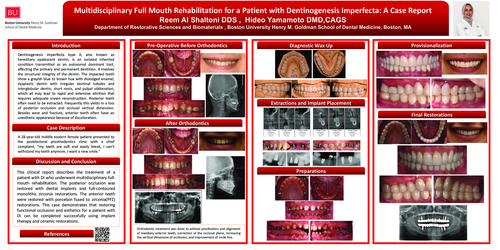
Dentinogenesis imperfecta type II, also known as hereditary opalescent dentin, is an isolated inherited condition transmitted as an autosomal dominant trait, affecting the primary and permanent dentition. It involves the structural integrity of the dentin. The impacted teeth show a grayish blue to brown hue with dislodged enamel, dysplastic dentin with irregular dentinal tubules and interglobular dentin, short roots, and pulpal obliteration, which all may lead to rapid and extensive attrition that requires adequate crown reconstruction. Posterior teeth often need to be extracted. Frequently this yields in a loss of posterior occlusion and occlusal vertical dimension. Besides wear and fracture, anterior teeth often have an unesthetic appearance because of discoloration.
Case Description :
A 28-year-old middle eastern female patient presented to the postdoctoral prosthodontics clinic with a chief complaint, “my teeth are soft and easily break, I can’t withstand my teeth anymore, and I want a new smile.”
Discussion and conclusion :
This clinical report describes the treatment of a patient with DI who underwent multidisciplinary full-mouth rehabilitation. The posterior occlusion was restored with dental implants and full-contoured monolithic zirconia restorations. The anterior teeth were restored with porcelain fused to zirconia(PFZ) restorations. Orthodontic treatment was done to achieve proclination and alignment of maxillary anterior teeth, correction of the occlusal plane, increasing the vertical dimension of occlusion, and improvement of smile line. This case demonstrates that restoring functional occlusion and esthetics for a patient with DI can be completed successfully using implant therapy and ceramic restorations.