105 posters, 2 topics, 24 sessions, 264 authors, 71 institutions
ePostersLive by SciGen Technologies S.A. All rights reserved.
2022 ACP Annual Session
2 - 5 November | Austin, TX

149
Digital Workflow for a tooth borne Stackable guide for a fully guided bone reduction and implant placement using magnetic connections.
Poster Presenter
Authors
Affiliations
Part of Topic
Case Presentation
Digital Workflow for a tooth borne stackable guide for a fully guided bone reduction and implant placement using magnetic connections.
Purpose:
Describe a workflow for the fabrication of Tooth borne stackable guide for bone reduction and implant placement using magnetic connections.
Introduction:
A 72-year-old male with terminal dentition, needing full mouth rehabilitation using implants. Crestal bone width was very thin requiring deepening of the implants and resection of the thin narrow bone above it, creating required prosthetic space, and hiding the junction between prosthesis and soft tissue.
Methodology:
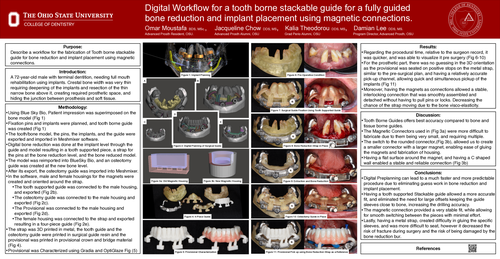
- Using Blue Sky Bio, Patient impression was superimposed on the bone model (Fig 1)
- Fixation pins and implants were planned, and tooth borne guide was created (Fig 1)
- The tooth/bone model, the pins, the implants, and the guide were exported and imported in Meshmixer software.
- Digital bone reduction was done at the implant level through the guide and model resulting in a tooth supported piece, a strap for the pins at the bone reduction level, and the bone reduced model.
- The model was reimported into BlueSky Bio, and an osteotomy guide was created at the new bone level.
- After its export, the osteotomy guide was imported into Meshmixer.
- In the software, male and female housings for the magnets were created and oriented around the strap.
- The tooth supported guide was connected to the male housing, and exported (Fig 2b).
- The osteotomy guide was connected to the male housing and exported (Fig 2c).
- The Provisional was connected to the male housing and exported (Fig 2d).
- The female housing was connected to the strap and exported resulting in a four-piece guide (Fig 2e).
- The strap was 3D printed in metal, the tooth guide and the osteotomy guide were printed in surgical guide resin and the provisional was printed in provisional crown and bridge material (Fig 4).
- Provisional was Characterized using Gradia and OptiGlaze Fig (5)
Results:
- Regarding the procedural time, relative to the surgeon record, it was quicker, and was able to visualize it pre surgery (Fig 6-10)
- For the prosthetic part, there was no guessing in the 3D orientation as the provisional was seated on positive stops on the metal strap, similar to the pre-surgical plan, and having a relatively accurate pick-up channel, allowing quick and simultaneous pickup of the implants (Fig 11)
- Moreover, having the magnets as connections allowed a stable, interlocking connection that was smoothly assembled and detached without having to pull pins or locks. Decreasing the chance of the strap moving due to the bone visco-elasticity.
Discussion:
- Tooth Borne Guides offers best accuracy compared to bone and tissue borne guides.
- The Magnetic Connectors used in (Fig 3a) were more difficult to fabricate due to them being very small, and requiring multiple.
- The switch to the rounded connector,(Fig 3b), allowed us to create a smaller connector with a larger magnet, enabling ease of gluing the magnets and fabrication of housing.
- Having a flat surface around the magnet, and having a C shaped wall enabled a stable and reliable connection (Fig 3b)
Conclusions:
- Digital Preplanning can lead to a much faster and more predictable procedure due to eliminating guess work in bone reduction and implant placement.
- Having a tooth supported Stackable guide allowed a more accurate fit, and eliminated the need for large offsets keeping the guide sleeves close to bone, increasing the drilling accuracy.
- The magnetic connection provided a very stable fit, while allowing for smooth switching between the pieces with minimal effort.
- Lastly, having a metal strap, created difficulty in gluing the specific sleeves, and was more difficult to seat, however it decreased the risk of fracture during surgery and the risk of being damaged by the bone reduction bur.