105 posters, 2 topics, 24 sessions, 264 authors, 71 institutions
ePostersLive by SciGen Technologies S.A. All rights reserved.
2022 ACP Annual Session
2 - 5 November | Austin, TX

145
Anodizing Technique to Improve Esthetics
Poster Presenter
Authors
Affiliations
Part of Topic
Case Presentation
ANODIZING TECHNIQUE TO IMPROVE ESTHETICS: CASE PRESENTATION
Ariana Alejandra Rodriguez, DDS. Damian Lee, DDS, MS, FACP
The Ohio State University - Advanced Prosthodontics Program
INTRODUCTION
Therefore, anodization is used to color abutments and conceal these grey undertones via light interference pattern phenomenon.
PURPOSE
MATERIALS AND METHOD
CASE REPORT (TECHNICAL STEPS)
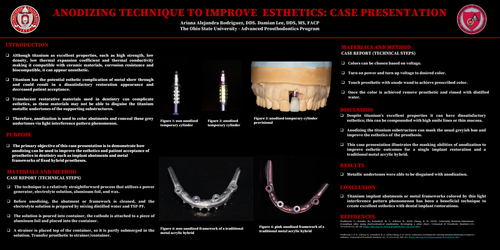
The technique is a relatively straightforward process that utilizes a power generator, electrolyte solution, aluminum foil, and wax.
Before anodizing, the abutment or framework is cleaned, and the electrolyte solution is prepared by mixing distilled water and TSP-PF.
The solution is poured into container, the cathode is attached to a piece of aluminum foil and placed into the container.
A strainer is placed top of the container, so it is partly submerged in the solution. Transfer prosthetic to strainer/container.
DISCUSSION
Despite titanium’s excellent properties it can have dissatisfactory esthetics; this can be compounded with high smile lines or thin mucosa.
Anodizing the titanium substructure can mask the usual greyish hue and improve the esthetics of the prosthesis.
This case presentation illustrates the masking abilities of anodization to improve esthetic outcomes for a single implant restoration and a traditional metal acrylic hybrid.
RESULTS
Metallic undertones were able to be disguised with anodization.