105 posters, 2 topics, 24 sessions, 264 authors, 71 institutions
ePostersLive by SciGen Technologies S.A. All rights reserved.
2022 ACP Annual Session
2 - 5 November | Austin, TX

138
Maxillary Anterior Digitally Guided Implant Workflow – From Snap on Smile to Zirconia Screw Retained Crowns
Poster Presenter
Authors
Affiliations
DUMMY, University of Alabama At Birmingham School of Dentistry
Part of Topic
Case Presentation
Maxillary Anterior Digitally Guided Implant Workflow
from Snap on Smile to Zirconia Screw Retained Crowns
Purpose
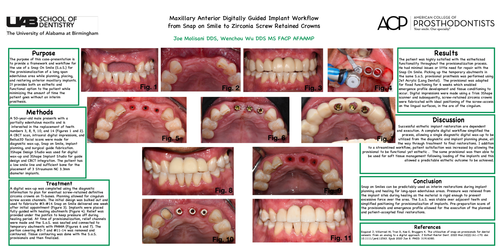
The purpose of this case-presentation is to provide a framework and workflow for the use of a Snap On Smile(S.o.S.) for the provisionalization of a long span edentulous area while planning, placing, and restoring anterior maxillary implants. It provides both an esthetic and functional option to the patient while minimizing the amount of time the patient goes without an interim prosthesis.
Methods
A 50-year-old male presents with a
partially edentulous maxilla and is
interested in the replacement of teeth
numbers 3, 8, 9, 10, and 14 (Figures 1 and 2). A CBCT scan, intraoral digital impressions, and Bellus3D facial scans were made for diagnostic wax-up, Snap on Smile, implant planning, and surgical guide fabrication. 3Shape Design Studio was used for digital wax-up and 3Shape Implant Studio for guide design and CBCT integration. The patient has a low smile line and sufficient bone for the placement of 3 Straumann NC 3.3mm diameter implants.
Treatment
A digital wax-up was completed using the diagnostic information to plan for eventual screw-retained definitive zirconia crowns on Ti-bases. Planning allowed for cingulum screw access channels. The initial design was bulked out and used to fabricate #3-#14 Snap on Smile delivered one week after initial appointment (Figure 3). Implants were placed fully guided with healing abutments (Figure 4). Relief was provided under the pontics to keep pressure off during healing period. At time of provisionalization, relief channels were made and the S.o.S. was seated and connected to temporary abutments with PMMA (Figures 6 and 7). The portion covering #3-7 and #11-14 was removed and contoured. Tissue contouring was done with the S.o.S. provisionals and then finalized.
Results
The patient was highly satisfied with the estheticsad functionality throughout the provisionalization process. He had minimal issues or little need for repair with the Snap On Smile. Picking up the temporary abutments in the same S.o.S. provisional prosthesis was performed using Jet Acrylic (Lang Dental). The provisional was adapted for fixed functioning for 6 weeks which enabled emergence profile development and tissue conditioning to occur. Digital impressions were made using a Trios 3Shape scanner and subsequently, screw-retained zirconia crowns were fabricated with ideal positioning of the screw-access on the lingual surfaces, in the are of the cingulum.
Discussion
Successful esthetic implant restoration are dependent upon careful planning and execution. A complete digital workflow simplified the
process, allowing a single diagnostic digital wax-up to be utilized from the diagnostic and implant planning phase, all the way through treatment to final restorations. I addition to a streamlined workflow, patient satisfaction was increased by allowing the provisional to be functional yet esthetic . The same provisional was then able to be used for soft tissue management following loading of the implants and this allowed a predictable esthetic outcome to be achieved.
Conclusion
Snap on Smiles can be predictably used as interim restorations during implant planning and healing for long-span edentulous areas. Pressure was relieved from the implant sites during healing as the material is rigid enough to prevent excessive force over the area. The S.o.S. was stable over adjacent teeth and simplified positioning for provisionalization of implants. Pre-preparation scans of the provisionals and emergence profile allowed for the execution of the planned and patient-accepted final restorations.
References
Esquivel J, Villarroel M, Tran D, Kee E, Bruggers K. The utilization of snap-on provisionals for dental veneers: From an analog to a digital approach. J Esthet Restor Dent. 2020 Mar;32(2):161-170. doi: 10.1111/jerd.12563. Epub 2020 Jan 8. PMID: 31916380.