105 posters, 2 topics, 24 sessions, 264 authors, 71 institutions
ePostersLive by SciGen Technologies S.A. All rights reserved.
2022 ACP Annual Session
2 - 5 November | Austin, TX

123
Prosthodontic Rehabilitation in Post-Radiation Patients: An Uphill Battle?
Poster Presenter
Authors
Affiliations
Part of Topic
Case Presentation
Head and Neck Cancer (HNC) remains one of the deadliest forms of cancer due to its high incidence and low survival rate.1 Various manifestations and devastating consequences of cancer treatment impose patients with significant burdens during the rehabilitative period.
Among various cancer treatments, Radiation Therapy (RT) is often the first line of therapy for patients with Head and Neck Cancer. These patients’ second greatest concern after HNC treatment is dental and oral health, after “Fear of Recurrence.”2 Hence, a dentist was the health care professional they most requested to see. Therefore, extensive prosthetic rehabilitation is required to restore speech, function, comfort, and normalcy.3
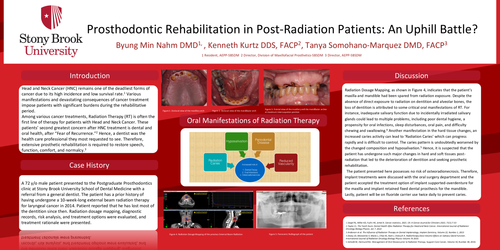
A 72 y/o male patient presented to the Postgraduate Prosthodontics clinic at Stony Brook University School of Dental Medicine with a referral from a general dentist. The patient has a prior history of having undergone a 10-week-long external beam radiation therapy for laryngeal cancer in 2014. Patient reported that he has lost most of the dentition since then. Radiation dosage mapping, diagnostic records, risk analysis, and treatment options were evaluated, and treatment rationale were presented.
Radiation Dosage Mapping, as shown in Figure 4, indicates that the patient’s maxilla and mandible had been spared from radiation exposure. Despite the absence of direct exposure to radiation on dentition and alveolar bones, the loss of dentition is attributed to some critical oral manifestations of RT. For instance, inadequate salivary function due to incidentally irradiated salivary glands could lead to multiple problems, including poor dental hygiene, a propensity for oral infections, sleep disturbances, oral pain, and difficulty chewing and swallowing.4 Another manifestation in the hard tissue changes, an increased caries activity can lead to ‘Radiation Caries’ which can progress rapidly and is difficult to control. The caries pattern is undoubtedly worsened by the changed composition and hyposalivation.5 Hence, it is suspected that the patient has undergone such major changes in hard and soft tissues post-radiation that led to the deterioration of dentition and seeking prosthetic rehabilitation.
The patient presented here possesses no risk of osteoradionecrosis. Therefore, implant treatments were discussed with the oral surgery department and the patient accepted the treatment option of implant supported-overdenture for the maxilla and implant retained fixed dental prosthesis for the mandible. Lastly, patient will be on fluoride carrier use twice daily to prevent caries.
1.Siegel RL, Miller KD, Fuchs HE, Jemal A. Cancer statistics, 2021. CA: A Cancer Journal for Clinicians 2021; 71(1):7-33