105 posters, 2 topics, 24 sessions, 264 authors, 71 institutions
ePostersLive by SciGen Technologies S.A. All rights reserved.
2022 ACP Annual Session
2 - 5 November | Austin, TX

122
Monolithic Zirconia survey crowns fabricated with Digital-Analogue Protocol
Poster Presenter
Authors
Affiliations
Part of Topic
Case Presentation
ABSTRACT
All-ceramic crowns are used as alternatives to conventional metal-ceramic crowns to restore single teeth. Traditionally, all-ceramic restorations possessed physical properties that contraindicated their use in many treatment situations. The strength that zirconia ceramics exhibit supports the hypothesis that, in specific situations, an all-ceramic crown may be used to restore removable partial denture (RPD) abutments in areas previously reserved for metal or metal-ceramic restorations.
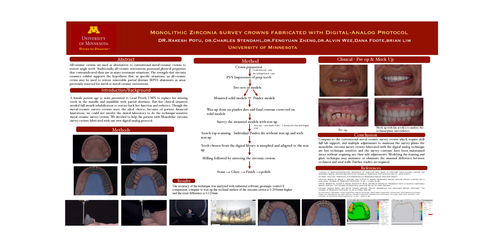
A female patient age 52 years presented to Grad Prosth UMN to replace her missing teeth in the maxilla and mandible with partial dentures. But her clinical situation needed full mouth rehabilitation to restore back her function and esthetics. Though the metal-ceramic survey crowns were the ideal choice, because of patient financial limitations, we could not involve the dental laboratory to do the technique-sensitive metal ceramic survey crowns. We decided to help the patient with Monolithic zirconia survey crowns fabricated with our own digital-analog protocol.
The accuracy of the technique was analyzed with industrial software geomagic control X comparison. compare to wax up the occlusal surface of the zirconia crown is 0.2956mm higher and the axial difference is 0.123mm
CONCLUSION
Compare to the conventional metal-ceramic survey crowns which require skill full lab support, and multiple adjustments to maintain the survey plains the monolithic zirconia survey crowns fabricated with the digital analog technique are less technique sensitive and the survey contours have been maintained intact without requiring any chair side adjustments. Modifying the staining and glaze technique may minimize or eliminate the minimal difference between occlusion and axial walls. Further studies are required.