105 posters, 2 topics, 24 sessions, 264 authors, 71 institutions
ePostersLive by SciGen Technologies S.A. All rights reserved.
2022 ACP Annual Session
2 - 5 November | Austin, TX

118
Case Presentation: Mid-Treatment Development of ACE Inhibitor Angioedema by a Maxillary Rehabilitation Patient
Poster Presenter
Authors
Affiliations
Part of Topic
Case Presentation
Case Presentation: Mid-Treatment Development of ACE Inhibitor Angioedema by a Maxillary Rehabilitation Patient
Anna K. Mcilwain, DDS1, David Felton, DDS, MS, FACP2
Resident1, Program Director 2
Division of Prosthodontics, Department of Comprehensive Oral Health, UNC Adams School of Dentistry
Introduction: Angioedema is a rare but potentially life-threatening side effect of angiotensin-converting enzyme (ACE) inhibitor therapy. Onset of most ACE inhibitor angioedema reactions is shortly after beginning therapy; however, approximately one-third of angioedema reactions occur after the patient is considered stable on ACE inhibitor therapy. While the exact etiology is unclear, risk factors for ACE inhibitor angioedema may include Black race, female gender, age older than 65 years, and a history of food/contact allergies. Environmental triggers can include trauma, smoking, NSAID use, and lidocaine use. ACE inhibitor angioedema reactions may range from mild (lip swelling) to severe (asphyxia due to tongue swelling). For this reason, it is important to identify patients at risk for ACE inhibitor angioedema, and to understand how to effectively manage such cases.
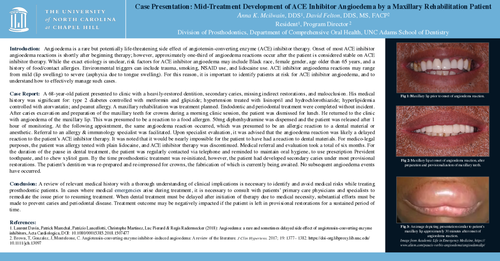
Case Report: A 68-year-old patient presented to clinic with a heavily-restored dentition, secondary caries, missing indirect restorations, and malocclusion. His medical history was significant for: type 2 diabetes controlled with metformin and glipizide; hypertension treated with lisinopril and hydrochlorothiazide; hyperlipidemia controlled with atorvastatin; and peanut allergy. A maxillary rehabilitation was treatment planned. Endodontic and periodontal treatment were completed without incident. After caries excavation and preparation of the maxillary teeth for crowns during a morning clinic session, the patient was dismissed for lunch. He returned to the clinic with angioedema of the maxillary lip. This was presumed to be a reaction to a food allergen. 50mg diphenhydramine was dispensed and the patient was released after 1 hour of monitoring. At the following appointment, the same angioedema reaction occurred, which was presumed to be an allergic reaction to a dental material or anesthetic. Referral to an allergy & immunology specialist was facilitated. Upon specialist evaluation, it was advised that the angioedema reaction was likely a delayed reaction to the patient’s ACE inhibitor therapy. It was noted that it would be nearly impossible for the patient to have had a reaction to dental materials. For medico-legal purposes, the patient was allergy tested with plain lidocaine, and ACE inhibitor therapy was discontinued. Medical referral and evaluation took a total of six months. For the duration of the pause in dental treatment, the patient was regularly contacted via telephone and reminded to maintain oral hygiene, to use prescription Prevident toothpaste, and to chew xylitol gum. By the time prosthodontic treatment was re-initiated, however, the patient had developed secondary caries under most provisional restorations. The patient’s dentition was re-prepared and re-impressed for crowns, the fabrication of which is currently being awaited. No subsequent angioedema events have occurred.
Conclusion:A review of relevant medical history with a thorough understanding of clinical implications is necessary to identify and avoid medical risks while treating prosthodontic patients. In cases where medical emergencies arise during treatment, it is necessary to consult with patients’ primary care physicians and specialists to remediate the issue prior to resuming treatment. When dental treatment must be delayed after initiation of therapy due to medical necessity, substantial efforts must be made to prevent caries and periodontal disease. Treatment outcome may be negatively impacted if the patient is left in provisional restorations for a sustained period of time.
References:
1.Laurent Davin, Patrick Marechal, Patrizio Lancellotti, Christophe Martinez, Luc Pierard & Regis Radermecker (2018): Angioedema: a rare and sometimes delayed side effect of angiotensin-converting enzyme inhibitors, Acta Cardiologica, DOI: 10.1080/00015385.2018.1507477
2. Brown, T, Gonzalez, J, Monteleone, C. Angiotensin-converting enzyme inhibitor–induced angioedema: A review of the literature. J Clin Hypertens. 2017; 19: 1377– 1382. https://doi-org.libproxy.lib.unc.edu/10.1111/jch.13097