105 posters, 2 topics, 24 sessions, 264 authors, 71 institutions
ePostersLive by SciGen Technologies S.A. All rights reserved.
2022 ACP Annual Session
2 - 5 November | Austin, TX

116
Simplified Digital and Conventional Workflow for Production of Prototype Complete Arch Fixed Implant-Supported Prosthesis
Poster Presenter
Authors
Affiliations
Part of Topic
Case Presentation
Title
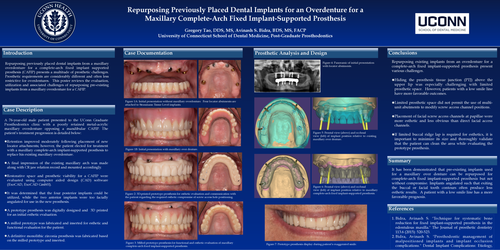
Repurposing Previously placed dental implants from an overdenture for a Maxillary Complete-Arch Fixed Implant-Supported Prosthesis
Introduction
Repurposing previously placed dental implants from a maxillary overdenture for a complete-arch fixed implant supported prosthesis (CAFIP) presents a multitude of prosthetic challenges. Prosthetic requirements are considerably different and often less restrictive for overdentures. This poster reviews the evaluation, utilization and associated challenges of repurposing pre-existing implants from a maxillary overdenture for a CAFIP.
Case Description:
A 76-year-old male patient presented to the UConn Graduate Prosthodontics clinic with a poorly retained metal-acrylic maxillary overdenture opposing a mandibular CAFIP. The patient’s treatment progression is detailed below:
-
Retention improved moderately following placement of new locator attachments; however, the patient elected for treatment with a maxillary complete-arch implant-supported prosthesis to replace his existing maxillary overdenture.
-
A final impression of the existing maxillary arch was made along with CR jaw relation record and mounted accordingly.
-
Restorative space and prosthetic viability for a CAFIP were evaluated using computer aided design (CAD) software (ExoCAD, ExoCAD GmbH).
-
It was determined that the four posterior implants could be utilized, while the two anterior implants were too facially angulated for use in the new prosthesis.
-
A prototype prosthesis was digitally designed and 3D printed for an initial esthetic evaluation.
-
A milled prototype was fabricated and inserted for esthetic and functional evaluation for the patient.
-
A definitive monolithic zirconia prosthesis was fabricated based on the milled prototype and inserted.
Conclusions:
Repurposing existing implants from an overdenture for a complete-arch fixed implant-supported prosthesis present various challenges.
-
Hiding the prosthesis tissue junction (PTJ) above the upper lip was especially challenging with limited prosthetic space. However, patients with a low smile line have more favorable outcomes.
-
Limited prosthetic space did not permit the use of multi-unit abutments to modify screw access channel positions.
-
Placement of facial screw access channels at papillae were more esthetic and less obvious than direct facial access channels.
-
If limited buccal ridge lap is required for esthetics, it is important to minimize its size and thoroughly validate that the patient can clean the area while evaluating the prototype prosthesis.
References:
-
Bidra, Avinash S. "Technique for systematic bone reduction for fixed implant-supported prosthesis in the edentulous maxilla." The Journal of prosthetic dentistry 113.6 (2015): 520-523.
-
Bidra, Avinash S. "Prosthodontic management of malpositioned implants and implant occlusion complications." Dental Implant Complications: Etiology, Prevention, and Treatment (2015): 559-5571.