105 posters, 2 topics, 24 sessions, 264 authors, 71 institutions
ePostersLive by SciGen Technologies S.A. All rights reserved.
2022 ACP Annual Session
2 - 5 November | Austin, TX

110
Maxillofacial Treatment Plan for the Rehabilitation of a Large Nasal Defect
Poster Presenter
Authors
Affiliations
Part of Topic
Case Presentation
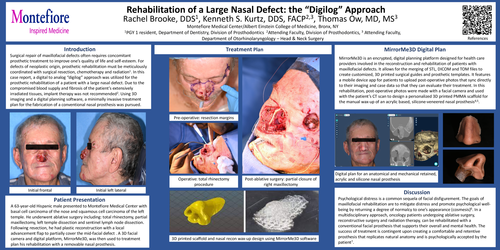
Rehabilitation of a Large Nasal Defect: the "Digilog" Approach
Introduction
Surgical repair of maxillofacial defects often requires concomitant prosthetic treatment to improve one’s quality of life and self-esteem. For defects of neoplastic origin, prosthetic rehabilitation must be meticulously coordinated with surgical resection, chemotherapy and radiation1. In this case report, a digital to analog “digilog” approach was utilized for the prostheticrehabilitation of a patient with a large nasal defect. Due to the compromised blood supply and fibrosis of the patient’s extensively irradiated tissues, implant therapy was not recommended2. Using 3D imaging and a digital planningsoftware, a minimally invasivetreatment plan for the fabrication of a conventional nasal prosthesis was pursued.
Patient Presentation
A 63-year-old Hispanic male presented to Montefiore Medical Center with basal cell carcinoma of the nose and squamous cell carcinoma of the left temple. He underwent ablative surgery including: total rhinectomy, partial maxillectomy, left temple dissection and sentinel lymph node dissection. Following resection, he had plasticreconstruction with a local advancement flap to partially cover the mid-facial defect . A 3D facial camera and digital platform, MirrorMe3D, was then used to treatment plan his rehabilitation with a removable nasal prosthesis.
MirrorMe3D Digital Plan
MirrorMe3D is an encrypted, digital planning platform designed for health care providers involved in the reconstruction and rehabilitation of patients with maxillofacial defects. It allows for the merging of STL, DICOM and TOM files to create customized, 3D printed surgical guides and prosthetic templates. It features a mobile device app for patients to upload post-operative photos that sync directly to their imaging and case data so that they can evaluate their treatment. In this rehabilitation, post-operative photos were made with a facial camera and used with the patient’s CT scan to design a personalized 3D printed PMMA scaffold for the manual wax-upof an acrylic based, silicone-veneered nasal prosthesis4,5.
Discussion
Psychological distress is a common sequela of facial disfigurement. The goals of maxillofacial rehabilitation are to mitigate distress and promote psychological well-being by returning a degree of normalcy to one’s appearance (cosmesis)6. In a multidisciplinary approach, oncology patients undergoing ablative surgery, reconstructive surgery and radiation therapy, can be rehabilitated with a conventional facial prosthesis that supports their overall and mental health. The success of treatment is contingent upon creating acomfortable and retentive prosthesis that replicates natural anatomy and is psychologically accepted by the patient7.
References
Leonardo Ciocca et al. J Oral Rehab 2001;43:4:311-315
Leonardo Ciocca et al. J Prostho 2016; 25:1:61-65
Sudarat Kiat-amnuay et al. J Prosthet Dent 2004;92:3:294-298
Sean K. Powell et al. Advanced Materials 2020;32:42:2001122
Mitsuhiro Tsuji et al. J Prostho 2004;13:3:179-183
Donna H. Hecker. J Prosthet Dent 2003;89:109-13
Antonio J. Godoy et al. J Prosthet Dent 1992;68:120-2