66 posters, 2 videos, 1 audios, 2 topics, 162 authors, 49 institutions
ePostersLive by SciGen Technologies S.A. All rights reserved.
American College of Prosthodontists - 2020 ANNUAL SESSION
November 4-7 | Virtual Meeting

81
Hybrid Digital Workflow to Fabricate Patient Specific 3D Printed Teeth with a PMMA Base - A laboratory technique.
Poster Presenter
Authors
Affiliations
Part of Topic
Case Presentation
Hybrid Digital Workflow to Fabricate Patient Specific 3D Printed Teeth with a PMMA Base- A Laboratory Technique
Vivia Sequeira BDS, Matthew S. Bryington DMD, MS, FACP
WVU School of Dentistry, Department of Restorative Dentistry, Graduate Prosthodontics Program
Objective:
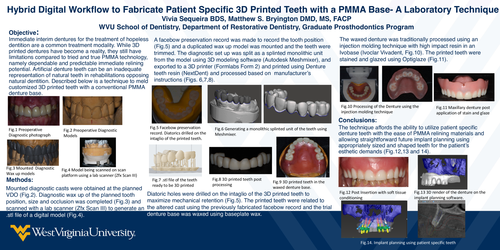
Immediate interim dentures for the treatment of hopeless dentition are a common treatment modality. While 3D printed dentures have become a reality, they still have limitations compared to tried and true PMMA technology, namely dependable and predictable immediate relining potential. Artificial denture teeth can be an inadequate representation of natural teeth in rehabilitations opposing natural dentition. Described below is a technique to meld customized 3D printed teeth with a conventional PMMA denture base.
Methods:
Mounted diagnostic casts were obtained at the planned VDO (Fig.2). Diagnostic wax up of the planned tooth position, size and occlusion was completed (Fig.3) and scanned with a lab scanner (Zfx Scan III) to generate an .stl file of a digital model (Fig.4). A facebow preservation record was made to record the tooth position (Fig.5) and a duplicated wax up model was mounted and the teeth were trimmed. The diagnostic set up was split as a splinted monolithic unit from the model using 3D modeling software (Autodesk Meshmixer), and exported to a 3D printer (Formlabs Form 2) and printed using Denture teeth resin (NextDent) and processed based on manufacturer’s instructions (Figs. 6,7,8). Diatoric holes were drilled on the intaglio of the 3D printed teeth to maximize mechanical retention (Fig.5). The printed teeth were related to the altered cast using the previously fabricated facebow record and the trial denture base was waxed using baseplate wax. The waxed denture was traditionally processed using an injection molding technique with high impact resin in an Ivobase (IvoclarVivadent, Fig.10). The printed teeth were stained and glazed using Optiglaze (Fig.11).
Conclusions:
The technique affords the ability to utilize patient specific denture teeth with the ease of PMMA relining materials and allowing straightforward future implant planning using appropriately sized and shaped teeth for the patient’s esthetic demands (Fig.12,13 and 14).