66 posters, 2 videos, 1 audios, 2 topics, 162 authors, 49 institutions
ePostersLive by SciGen Technologies S.A. All rights reserved.
American College of Prosthodontists - 2020 ANNUAL SESSION
November 4-7 | Virtual Meeting
74
Implant Surgical Planning in a Patient with Severely Atrophic Mandible
Poster Presenter
Authors
Yi-Cheng Lai, John Levon , Dean Morton, Chao-Chieh Yang, Wei-Shao Lin
Affiliations
Part of Topic
Case Presentation
Implant Surgical Planning In A Patient With Severely Atrophic Mandible
Objective
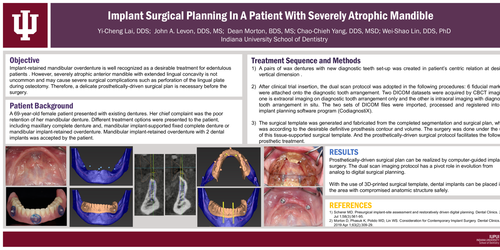
Implant-retained mandibular overdenture is well recognized as a desirable treatment for edentulous patients . However, severely atrophic anterior mandible with extended lingual concavity is not uncommon and may cause severe surgical complications such as perforation of the lingual plate during osteotomy. Therefore, a delicate prosthetically-driven surgical plan is necessary before the surgery.
Patient Background
A 69-year-old female patient presented with existing dentures. Her chief complaint was the poor retention of her mandibular denture. Different treatment options were presented to the patient, including maxillary complete denture and, mandibular implant-supported fixed complete denture or mandibular implant-retained overdenture. Mandibular implant-retained overdenture with 2 dental implants was accepted by the patient.
Treatment Sequenceand Methods
1)A pairs of wax dentures with new diagnostic teeth set-up was created in patient’s centric relation at desired vertical dimension .
2)After clinical trial insertion, the dual scan protocol was adopted in the following procedures: 6 fiducial markers were attached onto the diagnostic tooth arrangement. Two DICOM datasets were acquired by CBCT imaging, one is extraoral imaging on diagnostic tooth arrangement only and the other is intraoral imaging with diagnostic tooth arrangement in situ. The two sets of DICOM files were imported, processed and registered into an implant planning software program (CodiagnostiX).
RESULTS
Prosthetically-driven surgical plan can be realized by computer-guided implant surgery. The dual scan imaging protocol has a pivot role in evolution from analog to digital surgical planning. With the use of 3D-printed surgical template, dental implants can be placed in the area with compromised anatomic structure safely.
REFERENCES