66 posters, 2 videos, 1 audios, 2 topics, 162 authors, 49 institutions
ePostersLive by SciGen Technologies S.A. All rights reserved.
American College of Prosthodontists - 2020 ANNUAL SESSION
November 4-7 | Virtual Meeting
66
Computer-Aided-Designed Custom Tray for Fixed Prosthodontics: A novel and simple technique
Poster Presenter
Authors
Affiliations
Part of Topic
Case Presentation
Computer-Aided-Designed Custom Tray for Fixed Prosthodontics: A Novel and Simple Technique.
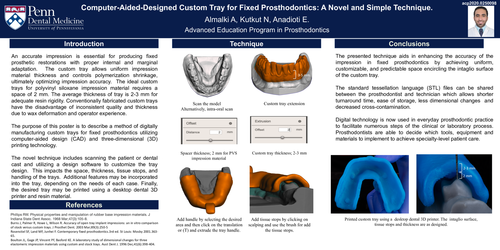
An accurate impression is essential for producing fixed prosthetic restorations with proper internal and marginal adaptation. The custom tray allows uniform impression material thickness and controls polymerization shrinkage, ultimately optimizing impression accuracy. The ideal custom trays for polyvinyl siloxane impression material requires a space of 2 mm. The average thickness of tray is 2-3 mm for adequate resin rigidity. Conventionally fabricated custom trays have the disadvantage of inconsistent quality and thickness due to wax deformation and operator experience.
The purpose of this poster is to describe a method of digitally manufacturing custom trays for fixed prosthodontics utilizing computer-aided design (CAD) and three-dimensional (3D) printing technology.
The novel technique includes scanning the patient or dental cast and utilizing a design software to customize the tray design. This impacts the space, thickness, tissue stops, and handling of the trays. Additional features may be incorporated into the tray, depending on the needs of each case. Finally, the desired tray may be printed using a desktop dental 3D printer and resin material.
Conclusions
The presented technique aids in enhancing the accuracy of the impression in fixed prosthodontics by achieving uniform, customizable, and predictable space encircling the intaglio surface of the custom tray.
The standard tessellation language (STL) files can be shared between the prosthodontist and technician which allows shorter turnaround time, ease of storage, less dimensional changes and decreased cross-contamination.
Digital technology is now used in everyday prosthodontic practice to facilitate numerous steps of the clinical or laboratory process. Prosthodontists are able to decide which tools, equipment and materials to implement to achieve specialty-level patient care.